
From the moment we entered Death Valley State Park, we knew it was going to be an incredible adventure. At first, the road wound its way through rust-red canyons, which soon gave way to the vast expanse of Death Valley, while the roads stretching into the distance beckoned us to explore and promised us a great time. However, before we reached Death Valley on our motorcycles, a few more adventures awaited us.
SHOSHONE AND AN UNEXPECTED VISIT TO TECOPA HOT SPRINGS
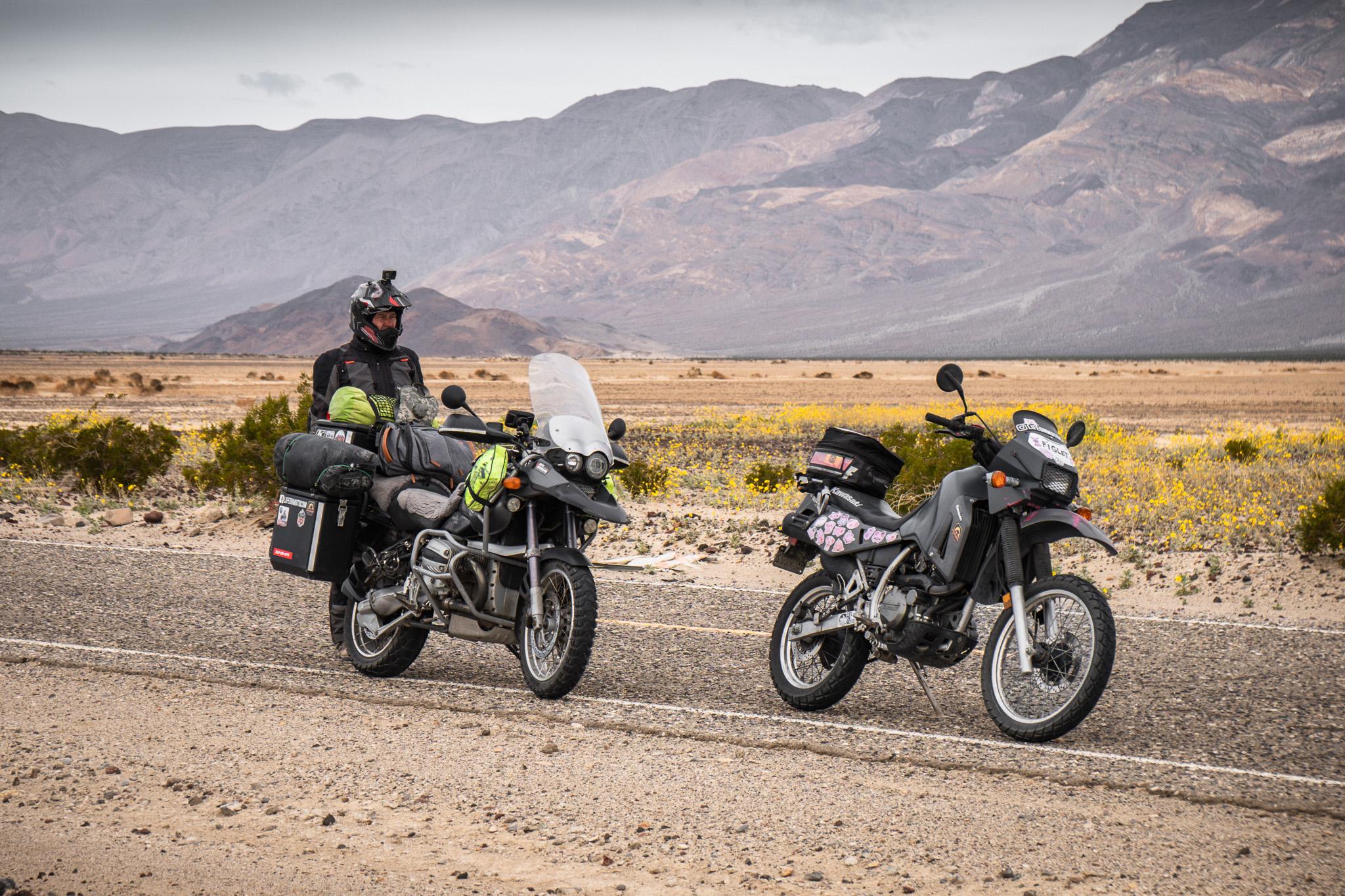
We left our hotel in Pahrump later than usual. We spent quite a bit of time in the parking lot fixing my Piglet, which had been stalling and cutting out for a few days. The symptoms pointed to a faulty side stand sensor, so we decided to disconnect it first. It was a bull’s-eye, but despite this minor glitch, our day was still significantly shortened. We set the GPS for a grocery store, since we planned to spend a few days in Death Valley, so provisions for the coming days were a must, and we set off down a road stretching straight to the horizon toward Shoshone.
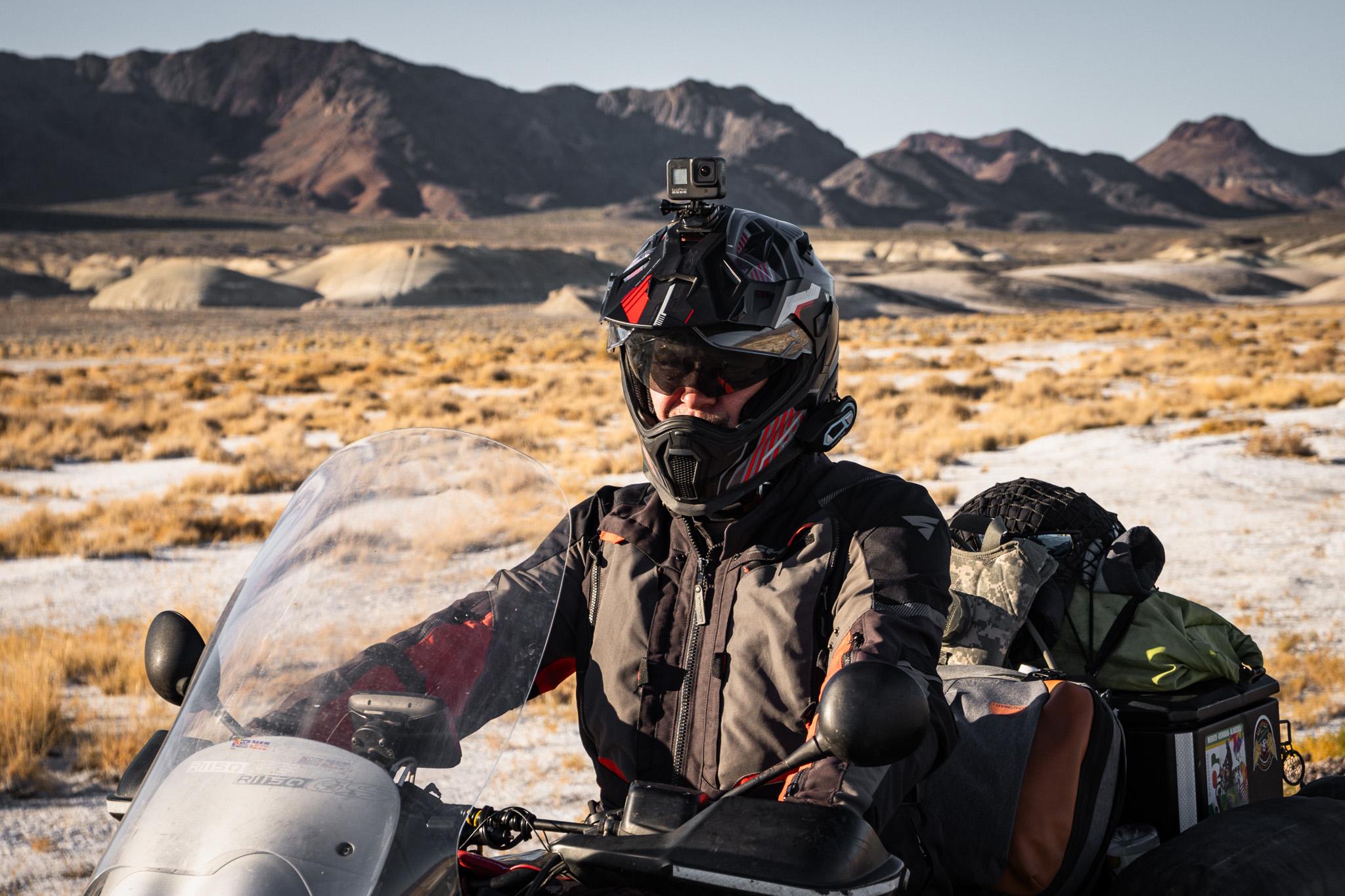
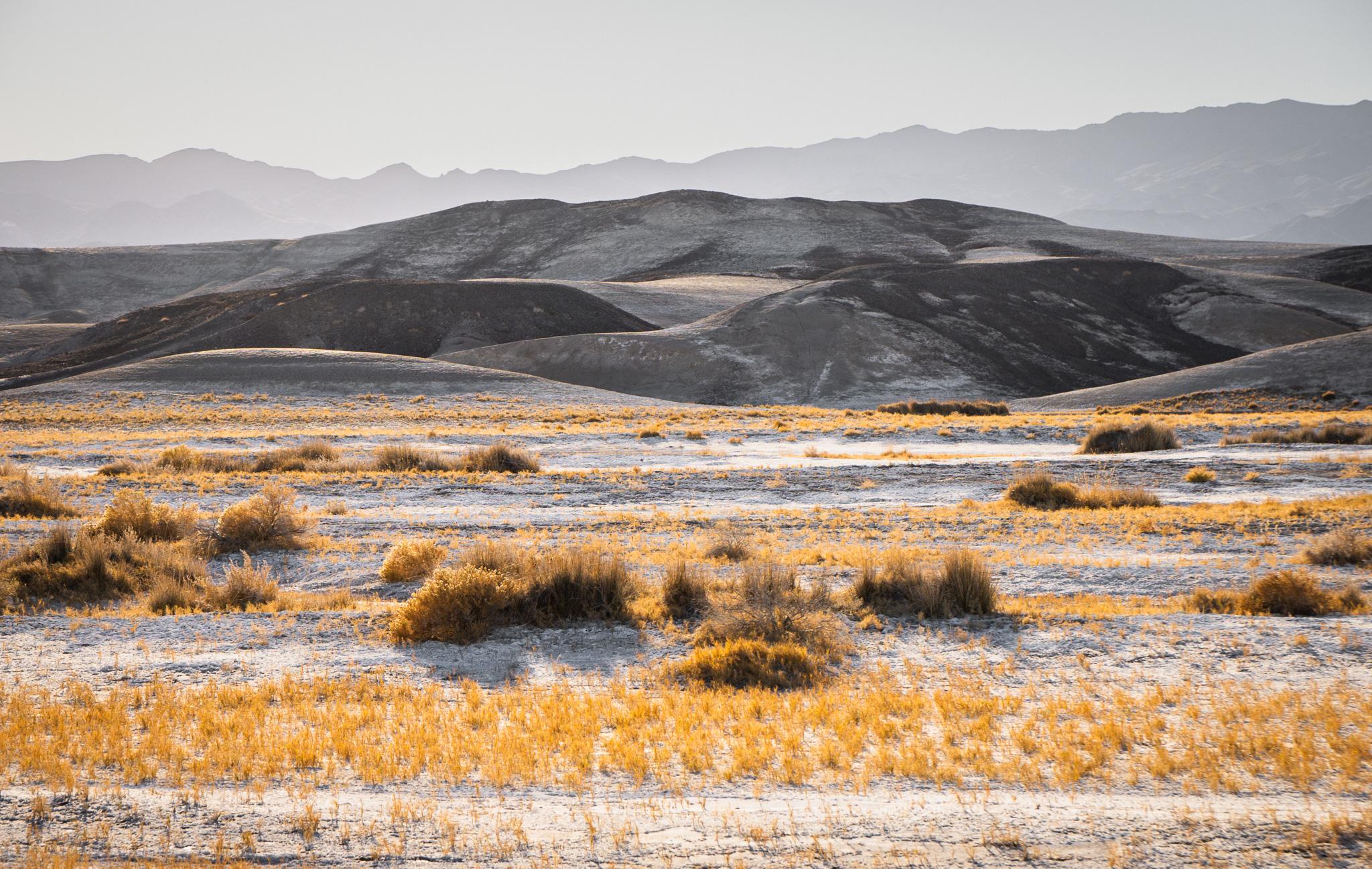
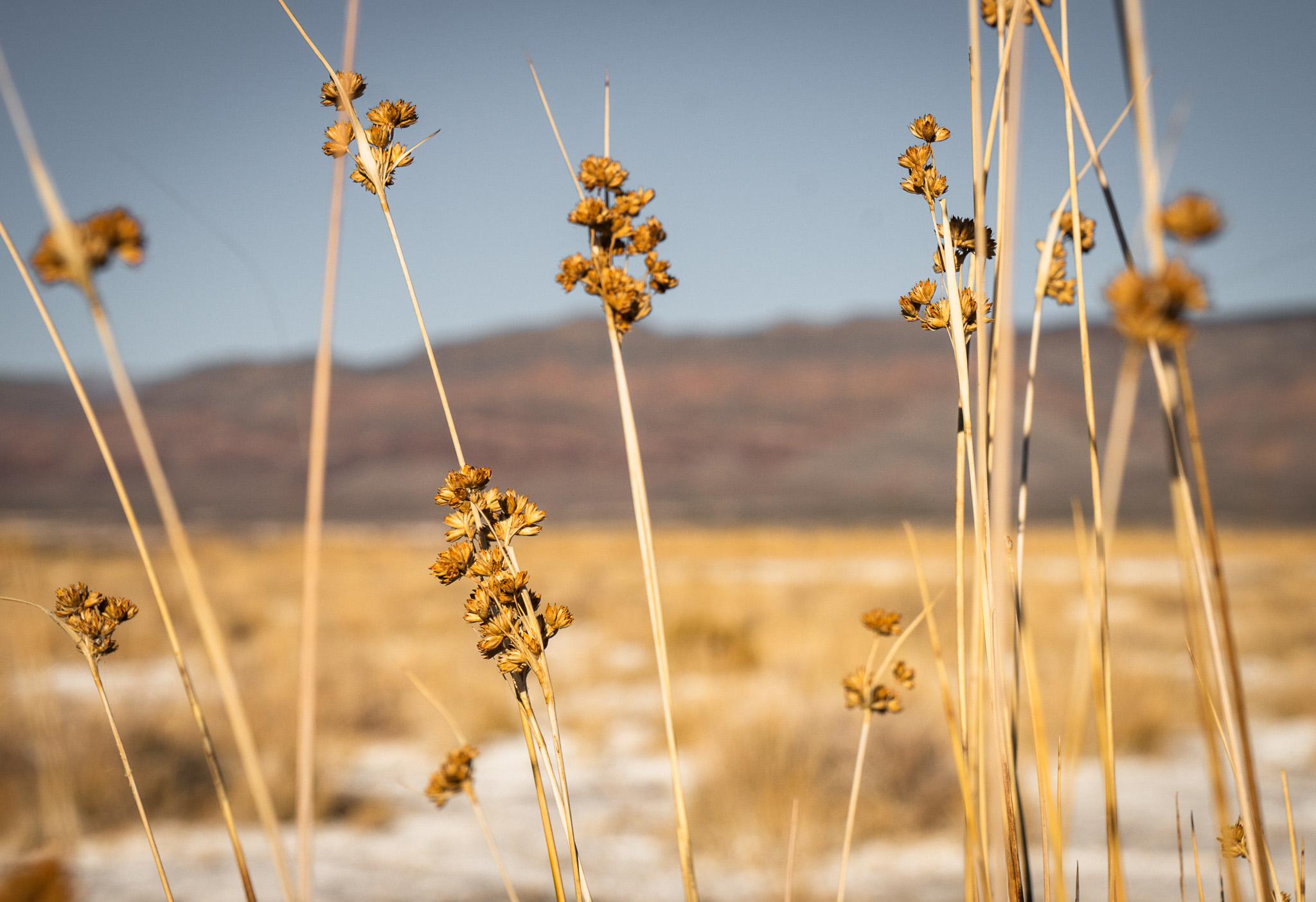
Once we arrived in Shoshone, we found an inn with a campground, a restaurant, a gas station, a museum with a small gift shop, and even an airport. But when we got there, we were still the only people around. The place looked like it had been abandoned long ago. The restaurant was temporarily closed, and there were no cars in front of the inn or at the gas station. We wandered around the area for a bit and were about to move on when a car pulled up next to our motorcycles. Two women got out, and one of them, upon hearing Polish, immediately laughed.
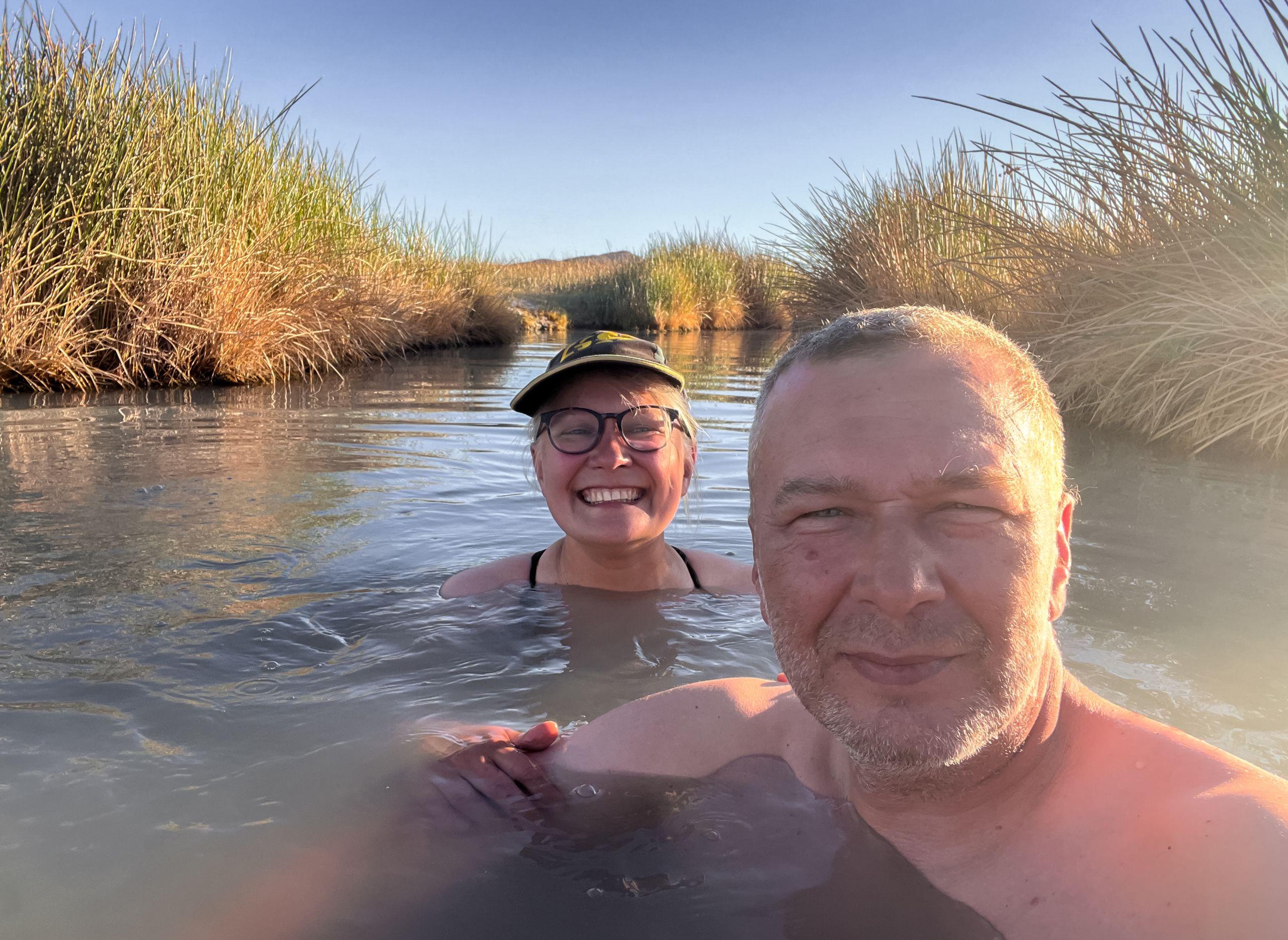
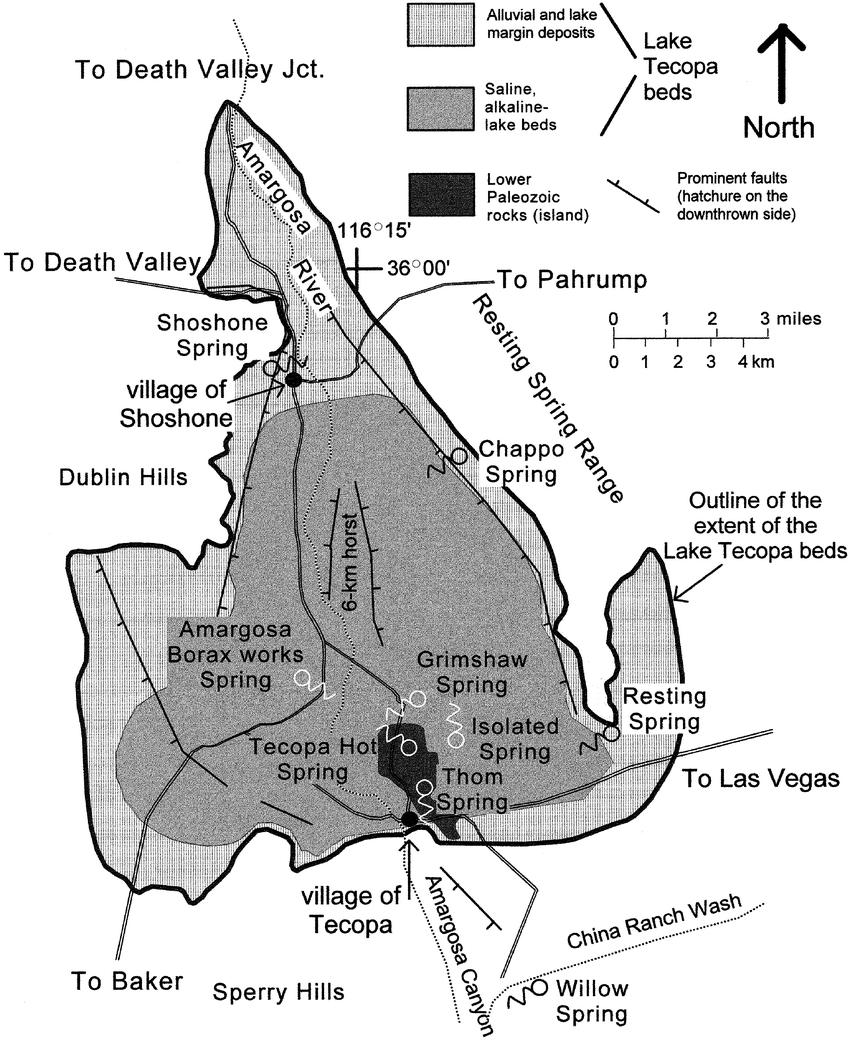
It was Mrs. Anna, who had emigrated from Poland many years ago. She had met her husband and started a family. She was currently traveling through California with her mother-in-law – her mother wanted to see once again the places she remembered from her youth. During that brief encounter, we learned more about the area than from any guidebook, and thanks to them, an hour later, instead of driving along the road through the endless plains of Death Valley, we were sitting neck-deep in the hot springs of Tecopa.
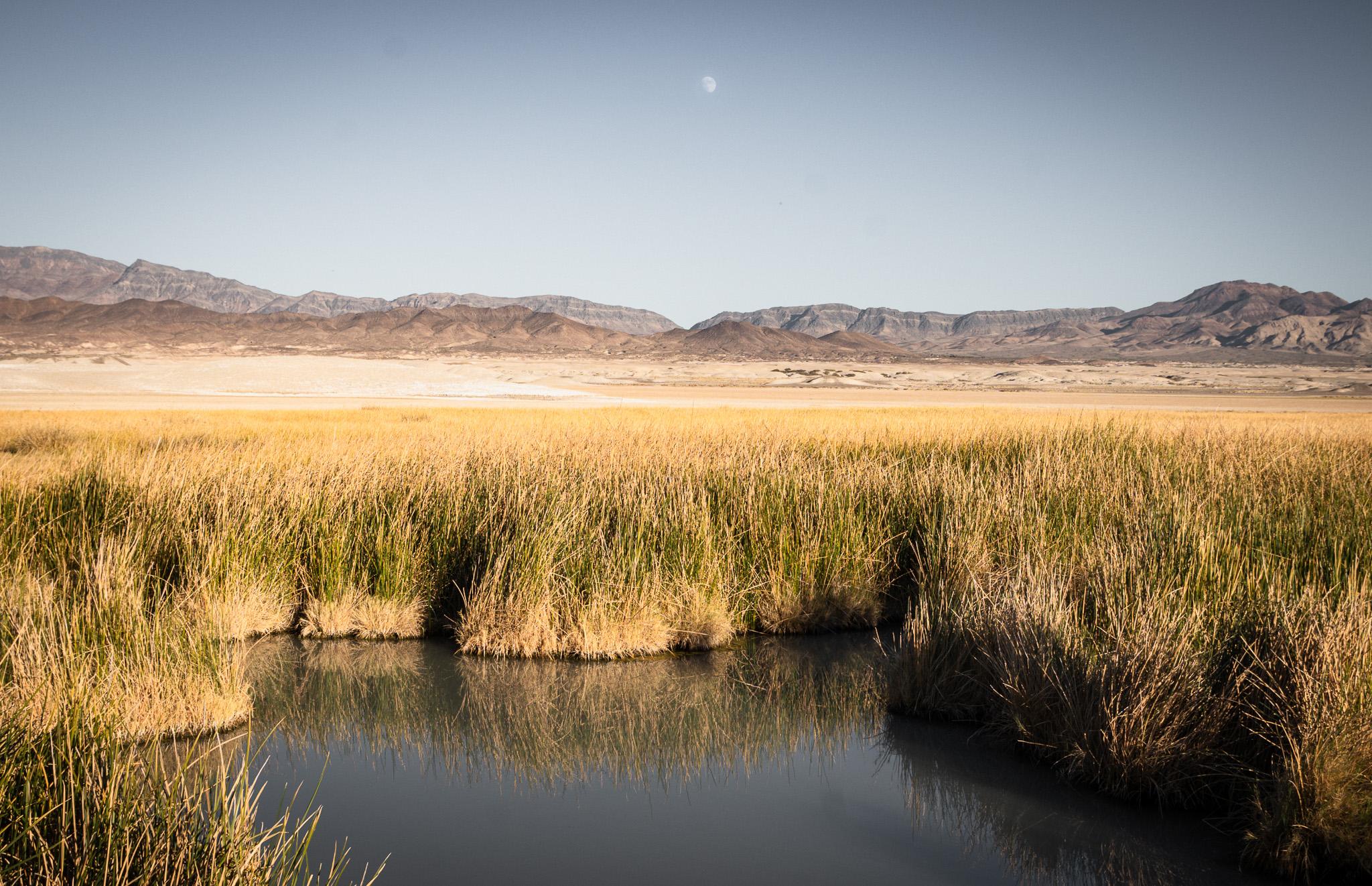
AMAZING HOT SPRINGS RIGHT NEXT TO DEATH VALLEY
The afternoon sun slowly painted the surrounding hills, first in gold, then in orange. The water was pleasantly warm and relaxing. It’s easy to lose yourself in places like this, to forget about time, but when the first stars began to twinkle cheerfully at us in the sky, it was a sign that we had to end our swim if we didn’t want to drive after dark.
We went back a bit along the road we already knew, and then turned onto a side gravel road. It looked pretty good, but after a while there was a lot of rutted, loose gravel… And I’m sure many of you can already guess how this ended. Just as you’d expect – Piglet’s rear wheel slipped, and with my limited experience, I couldn’t control the motorcycle, and a moment later I was lying on the ground in an epic way. Piglet lay next to me, stuck in a pile of gravel, right at a fork in the road. Brushing the sand and dust off myself, I looked at Piglet – the poor thing was scratched up, with a broken clutch lever and a bent fender. With Szymek’s help, I pushed the motorcycle a dozen or so meters further to the spot where, ironically, we were just about to set up camp, but I decided to take a tumble a few meters short of it.
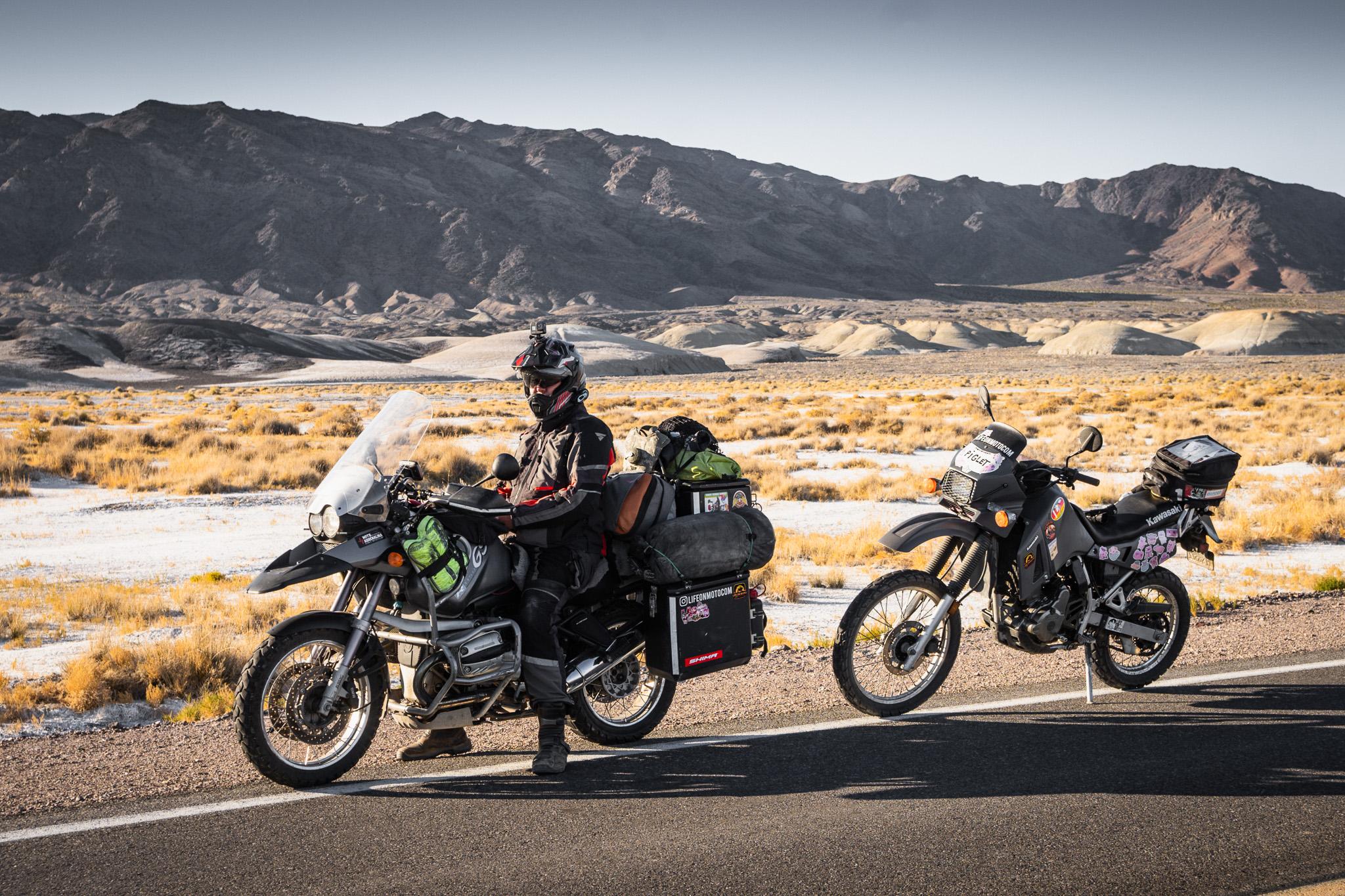
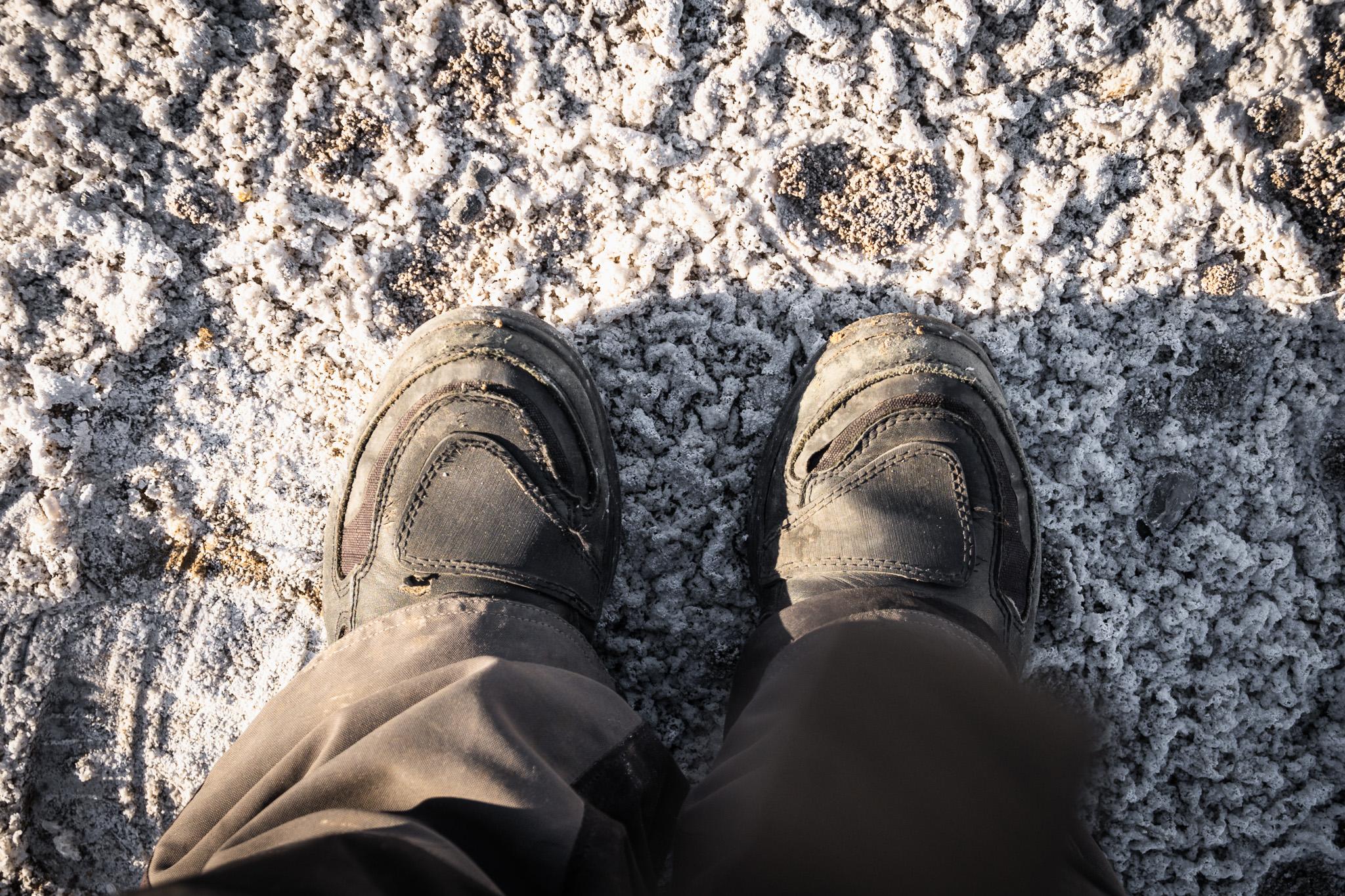
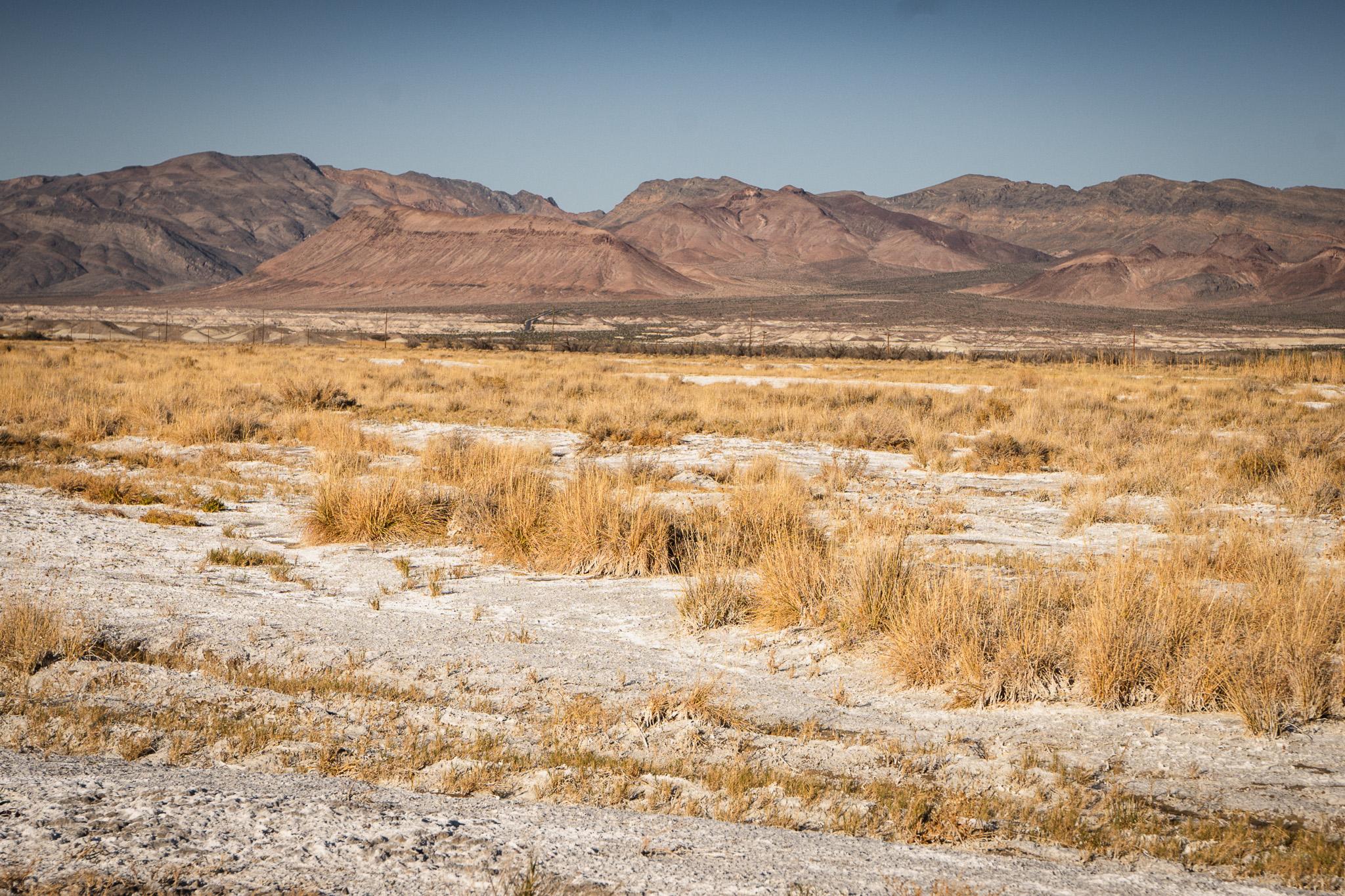
PAHRUMP AGAIN AND A BEAUTIFUL PLACE TO STAY ON BLM LAND NEAR THE CITY
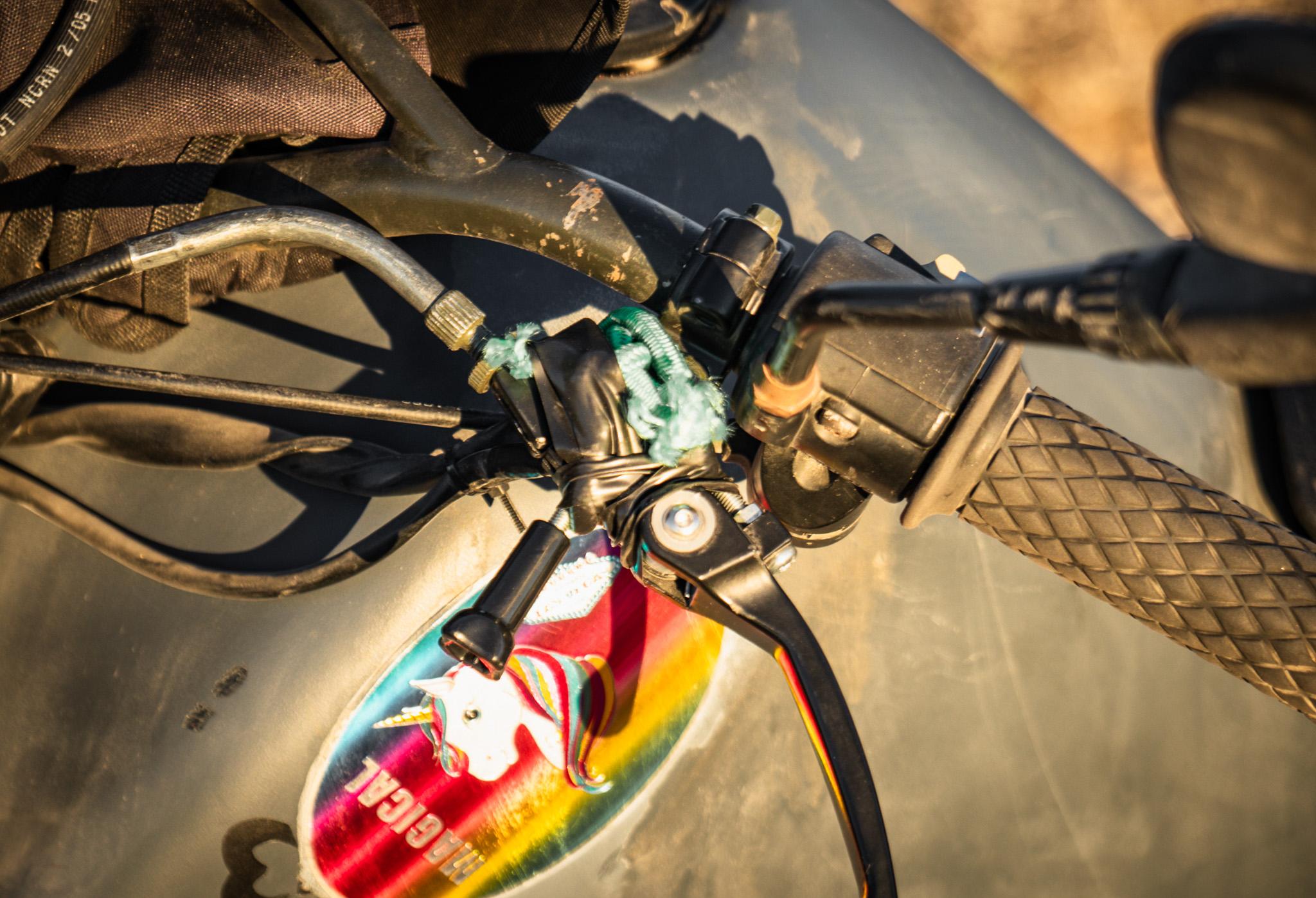
In the morning, we discovered that the handle had snapped in the worst possible place – right where it was attached to the handlebars. We weren’t able to glue it back together in a way that would keep it moving. Szymek improvised and, using zip ties, electrical tape, rubber from resistance bands, and a screw from a GoPro, managed to fix the linkage enough that it worked and would let us get back to Pahrump, where we’d spotted a few motorcycle shops the day before.
At the first motorcycle shop we found, none of the handlebars they had in stock unfortunately fit my Piggy. The guys offered to order one for us, but not until Tuesday at the earliest, and it was only Friday. We didn’t want to waste so many days waiting, so we drove to the next shop. A Kawasaki dealership – we’re sure to find something here, I thought. And we probably would have, if it hadn’t been closed. Also until Tuesday. We had one more stop on our map – a hardware store, where they often have all sorts of odds and ends, so maybe we’d find a handle there. We pulled up to the store, explained our problem to the owner, and he called over an employee who repaired lawn mowers and other garden equipment. I started laughing to myself, thinking that not only was Piglet all scratched up and broken, but they also wanted to put a lawn mower handle on him. What a weirdo. Luckily, the owner didn’t have a lawn mower handle that fit Piglet, but he turned out to be a motorcyclist and told us that he probably had a spare one in his garage and could bring it to us first thing in the morning. Woo-hoo!
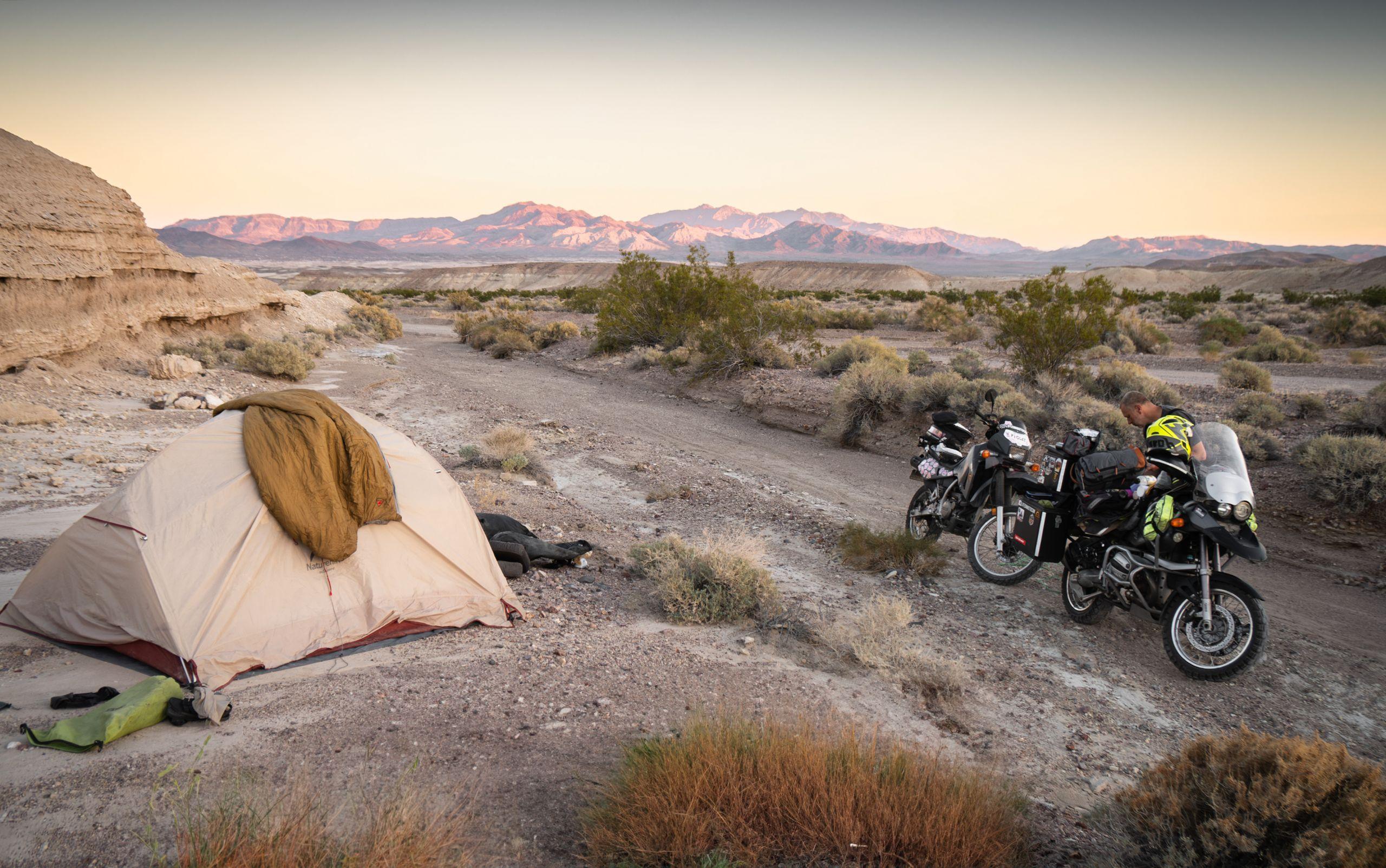
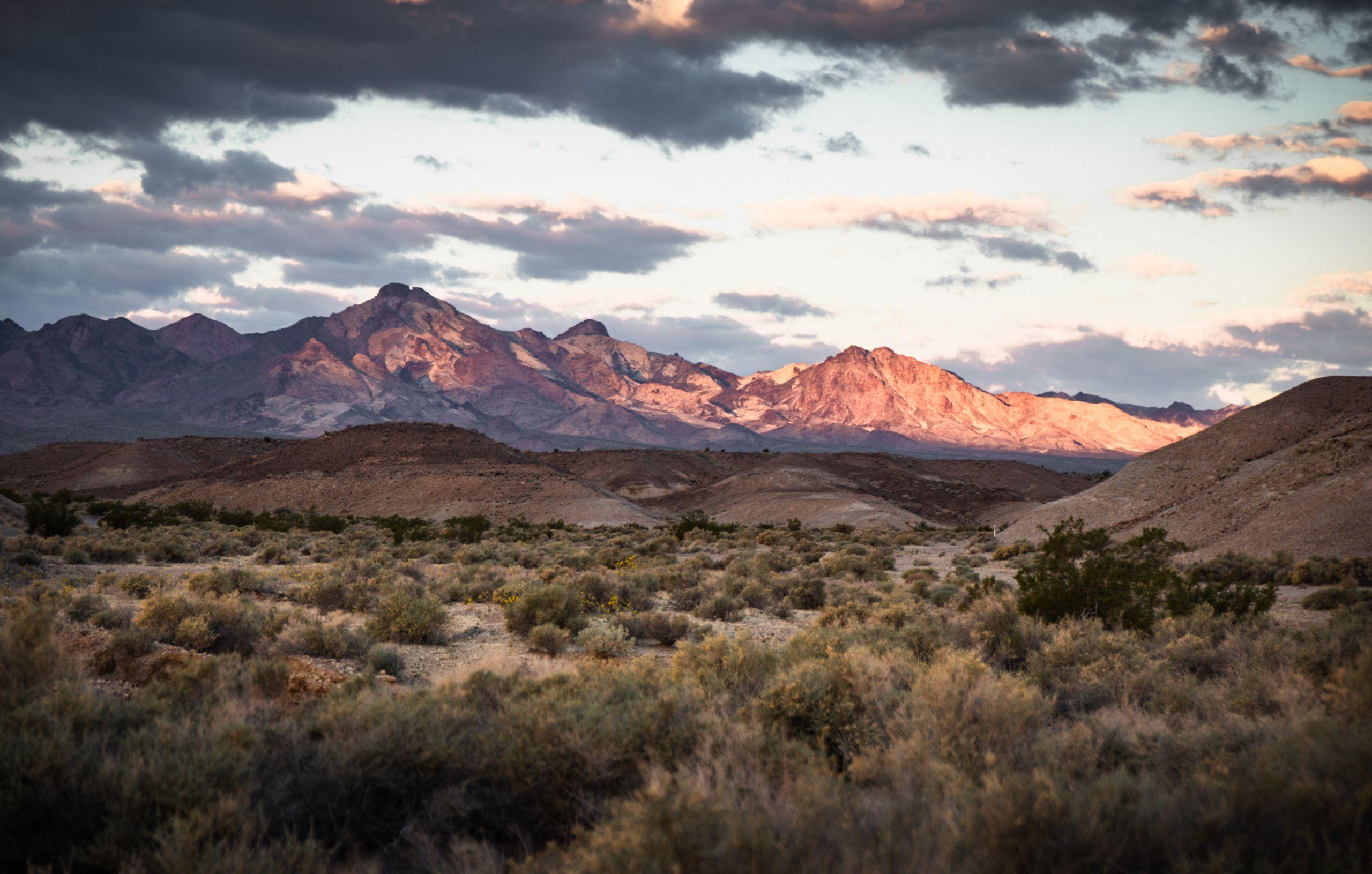
We spent the rest of the day and night on the vast BLM lands surrounding the town. We got up early. The plan was to pack up our camp as quickly as possible and be near the store by around 8 a.m. We wanted to fix the door handle as soon as possible and head back toward Death Valley. We did exactly as we had planned. The man at the hardware store was waiting for us first thing in the morning with a replacement latch; everything was going smoothly. We removed the old latch, installed the new one, and… unfortunately, it turned out that due to a slightly different design of the clutch cable, even after loosening it, it was so taut that I couldn’t squeeze the latch. So we went back to the earlier setup with zip ties and rubber, which had worked fine up to that point. That day I learned that if something works, you just keep going, and without waiting for another handle, we headed toward Death Valley.
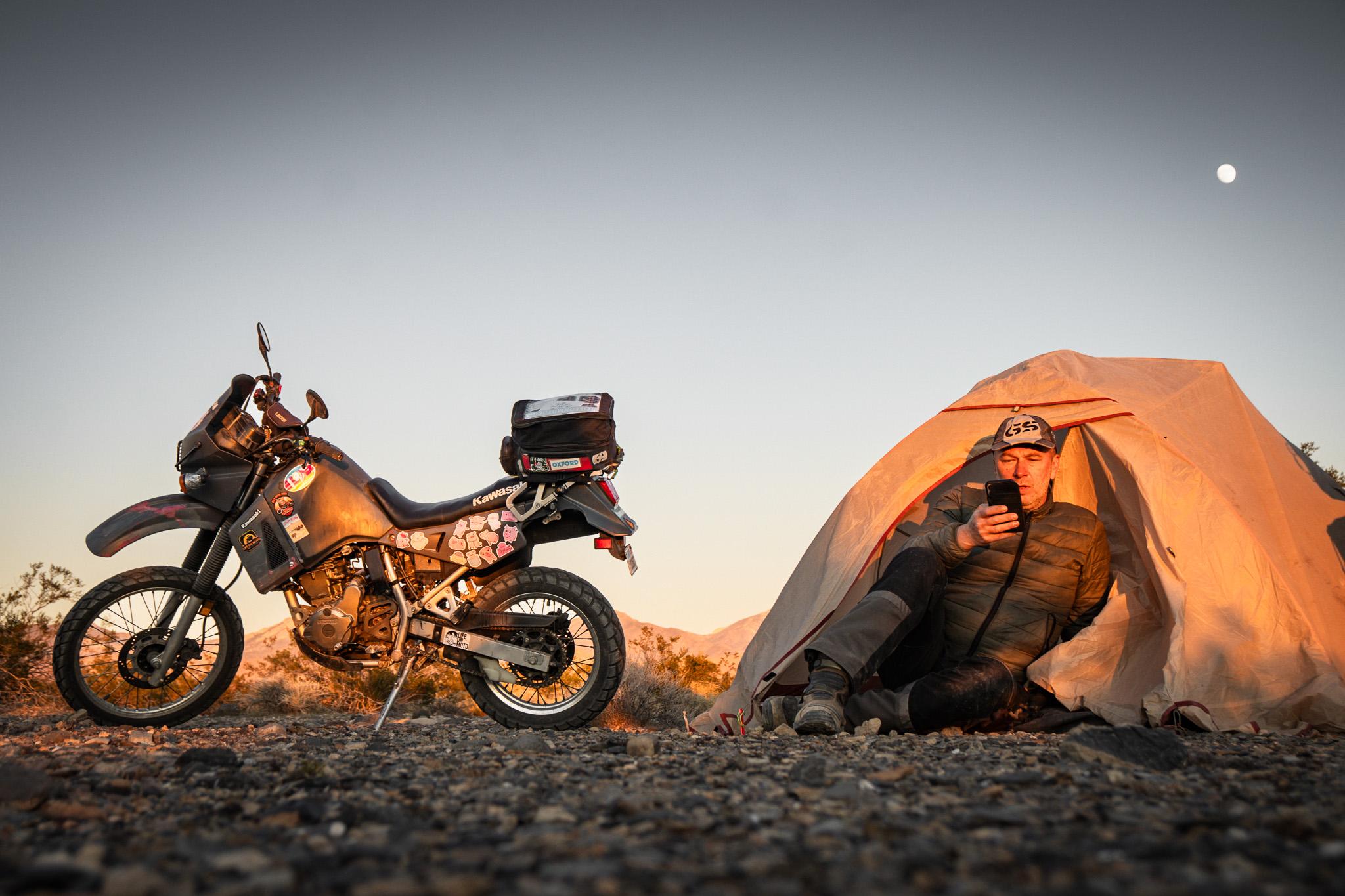
MOTORCYCLING THROUGH DEATH VALLEY – ZABRISKIE POINT
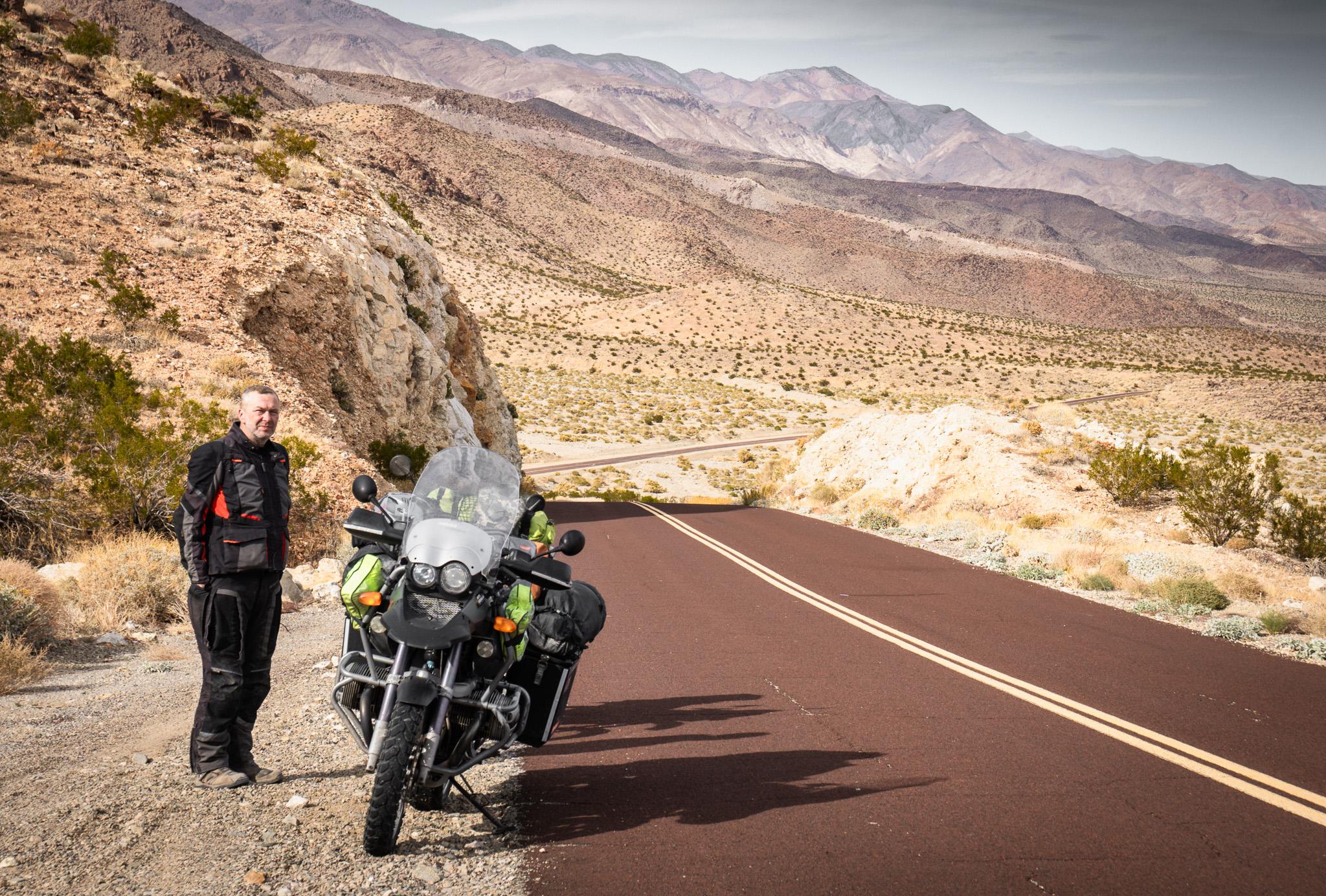
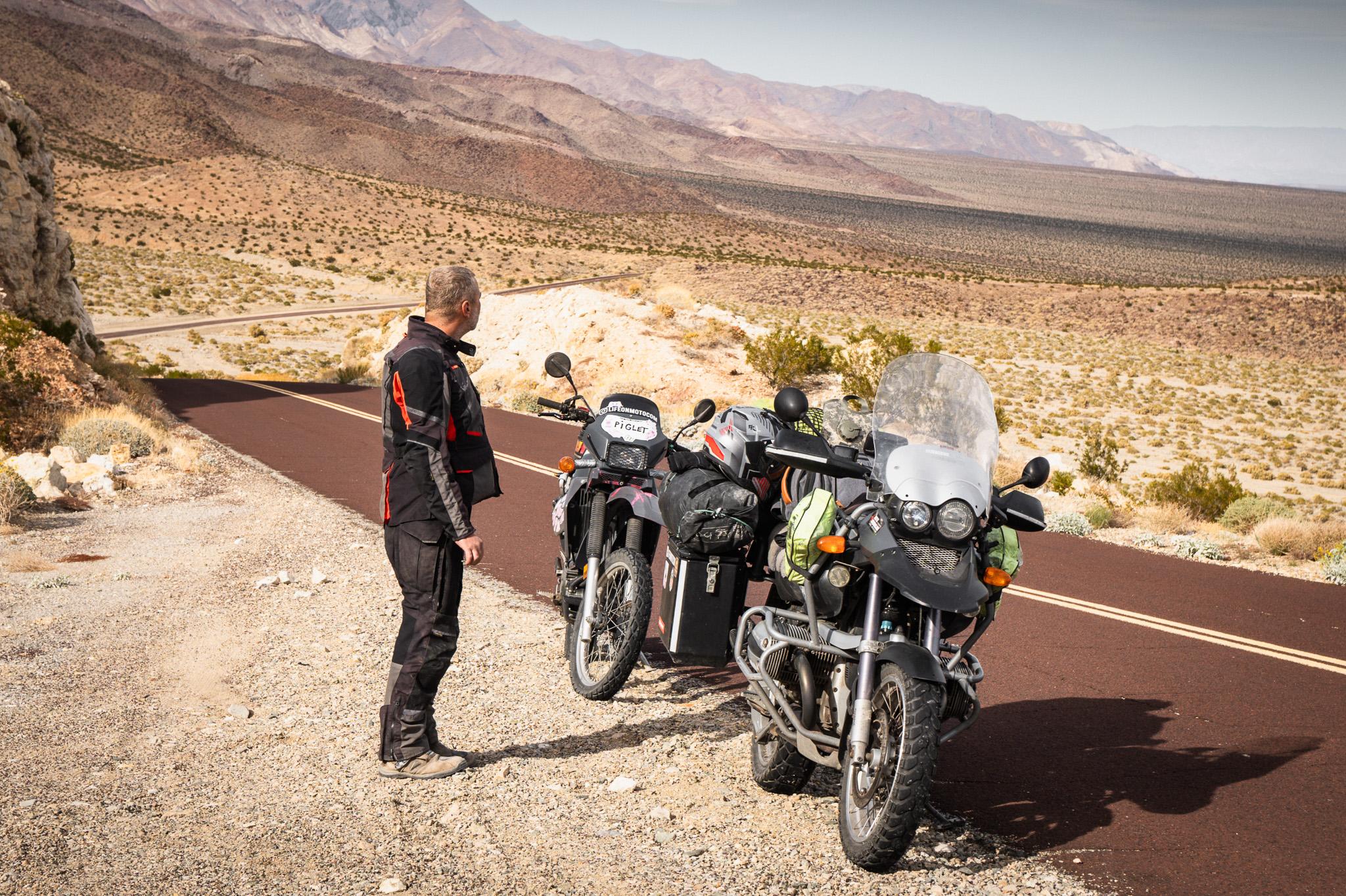
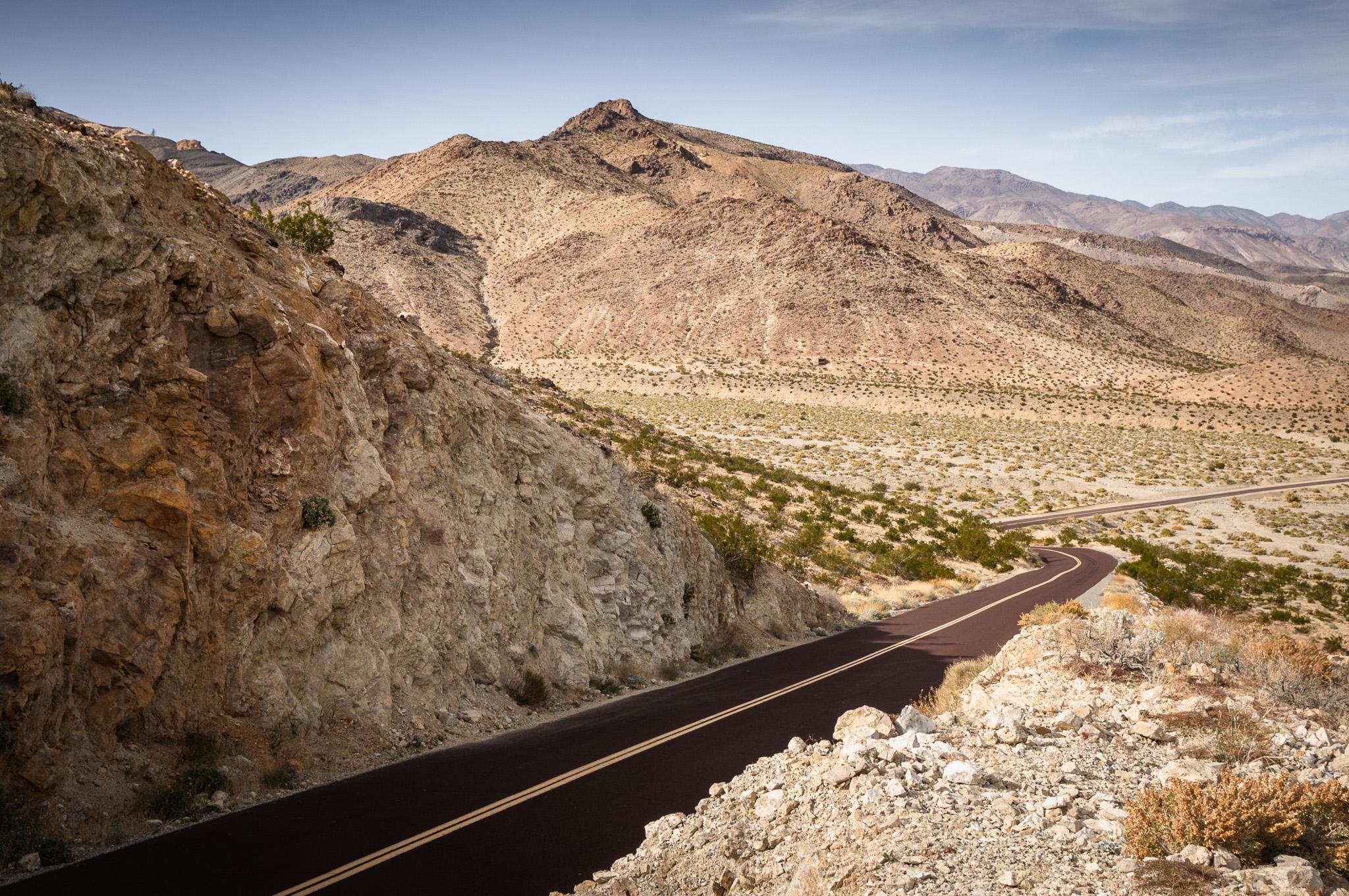
This time, we didn’t head toward Shoshone from Pahrump. We chose a different route – through the Amargosa Valley, and then along Route 190 toward Death Valley. As soon as we left the city, we were once again surrounded by desert landscapes and mountains looming somewhere on the horizon. We love that sense of freedom that comes from the endless expanse, the wind whistling through our helmets, and the steady rhythm of our motorcycles’ engines.
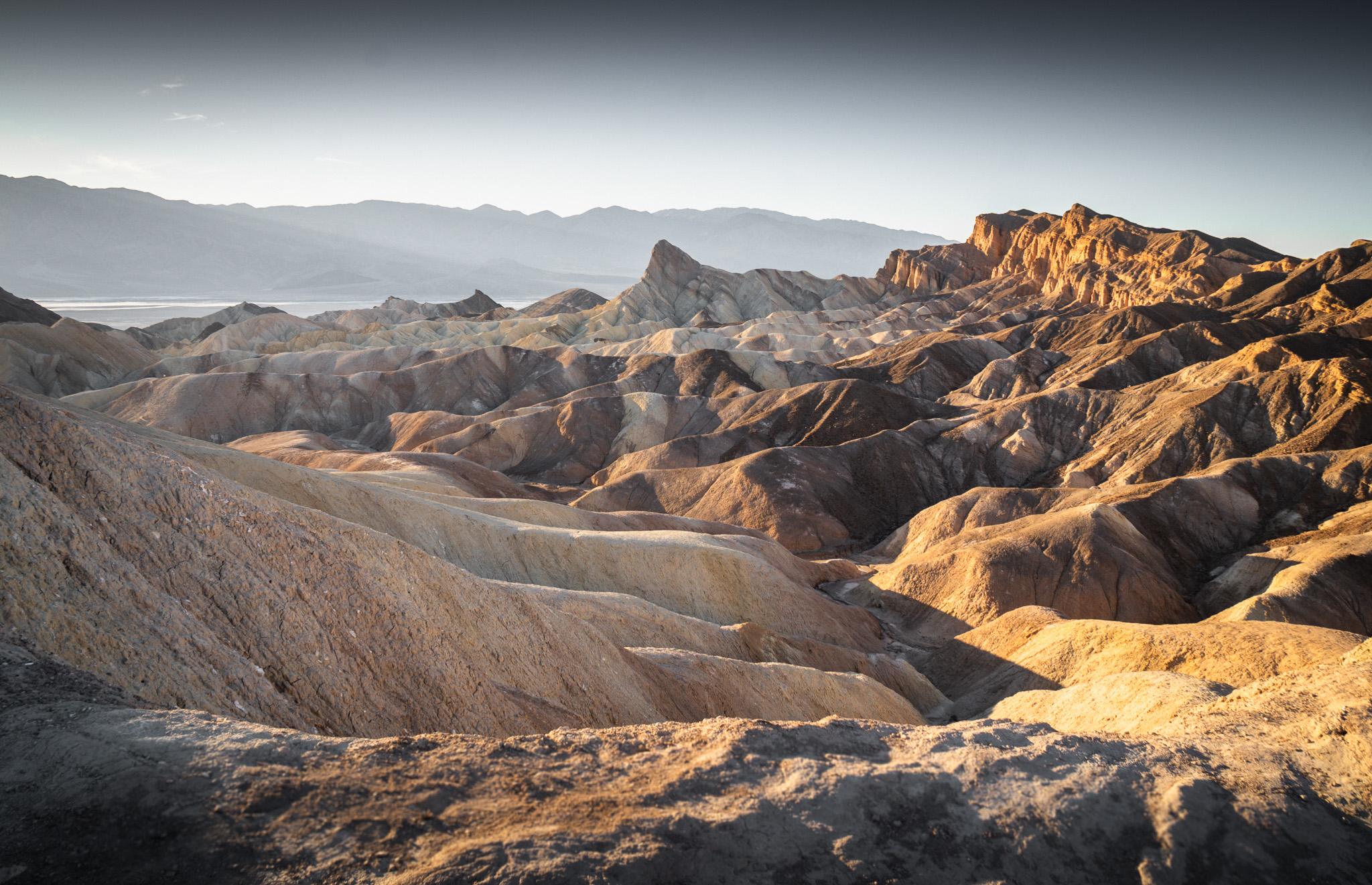
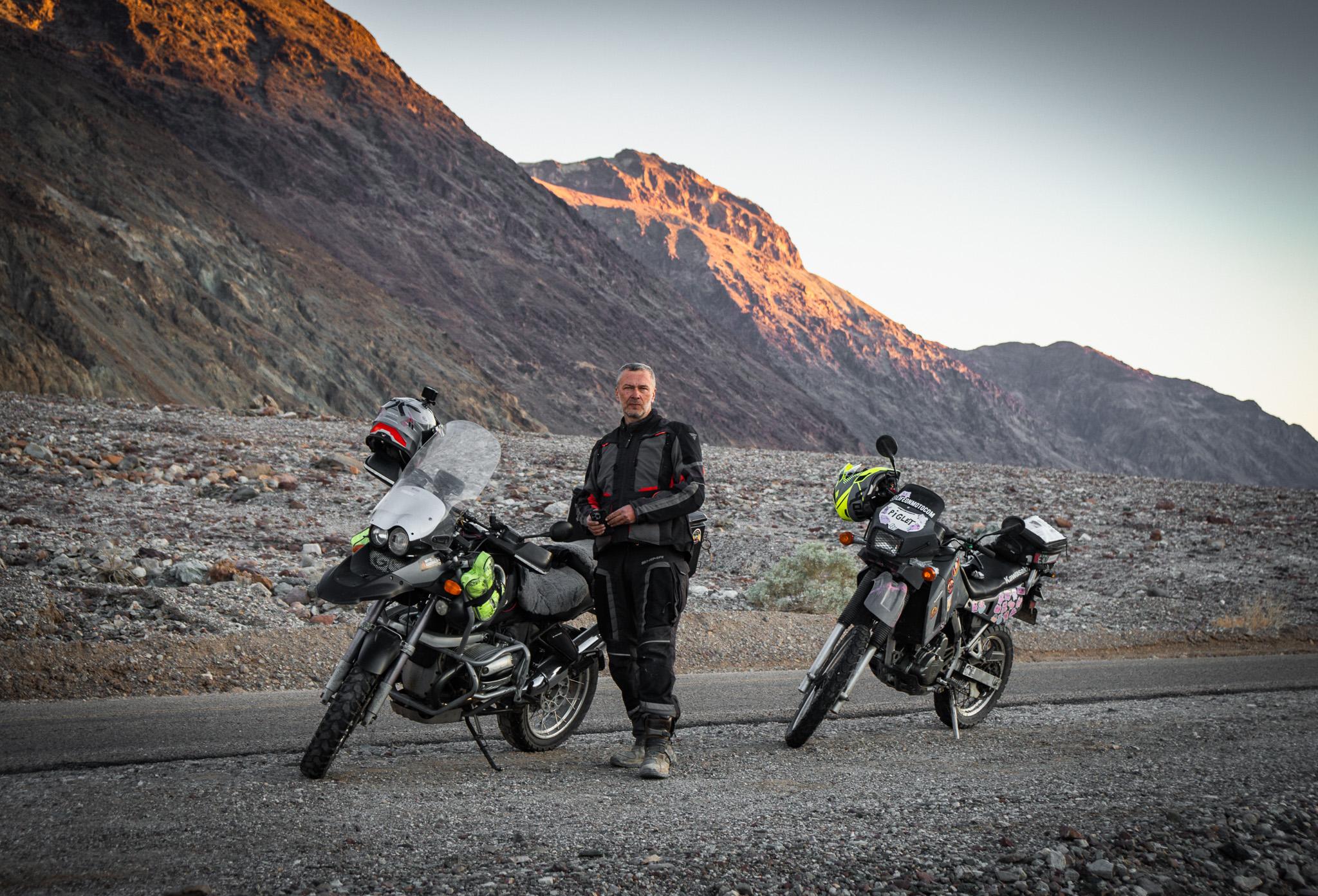
The closer we got to Death Valley, the closer we got to the mountains. At one point, the emptiness gave way to the rust-colored rocks of towering canyons. We passed the famous Zabriskie Point, to which we returned later that same day – but first, our destination was the campground. We still had a few hours until evening, and that’s when the sun illuminates the hills visible from the viewpoint most beautifully. A moment later, the canyons gave way once again to the vast expanse of Death Valley, which we traversed on our motorcycles, heading toward Furnace Creek. Somewhere to the right, the green palm trees of The Inn flashed by, contrasting almost unrealistically with the desert landscape surrounding them.
We parked in the spot that most resembled the center. Across the street was a gas station with outrageously high fuel prices, but it was good to know it was nearby in case we needed it – and that matters in places like this. Nearby was the Visitor Center, where you could pay for camping, buy admission tickets, maps, books, and other park souvenirs. Next to it was a campground that didn’t look particularly inviting – concrete, with evenly marked-out sites. Fortunately, that wasn’t where we were staying. Our campsite, Texas Springs, was located a bit higher up, on a nearby hill, among dwarf trees and shrubs that provided a bit of privacy. We found a pleasant spot with a fire pit and a bench, pitched our tent, left our things, and returned to Zabriskie Point.
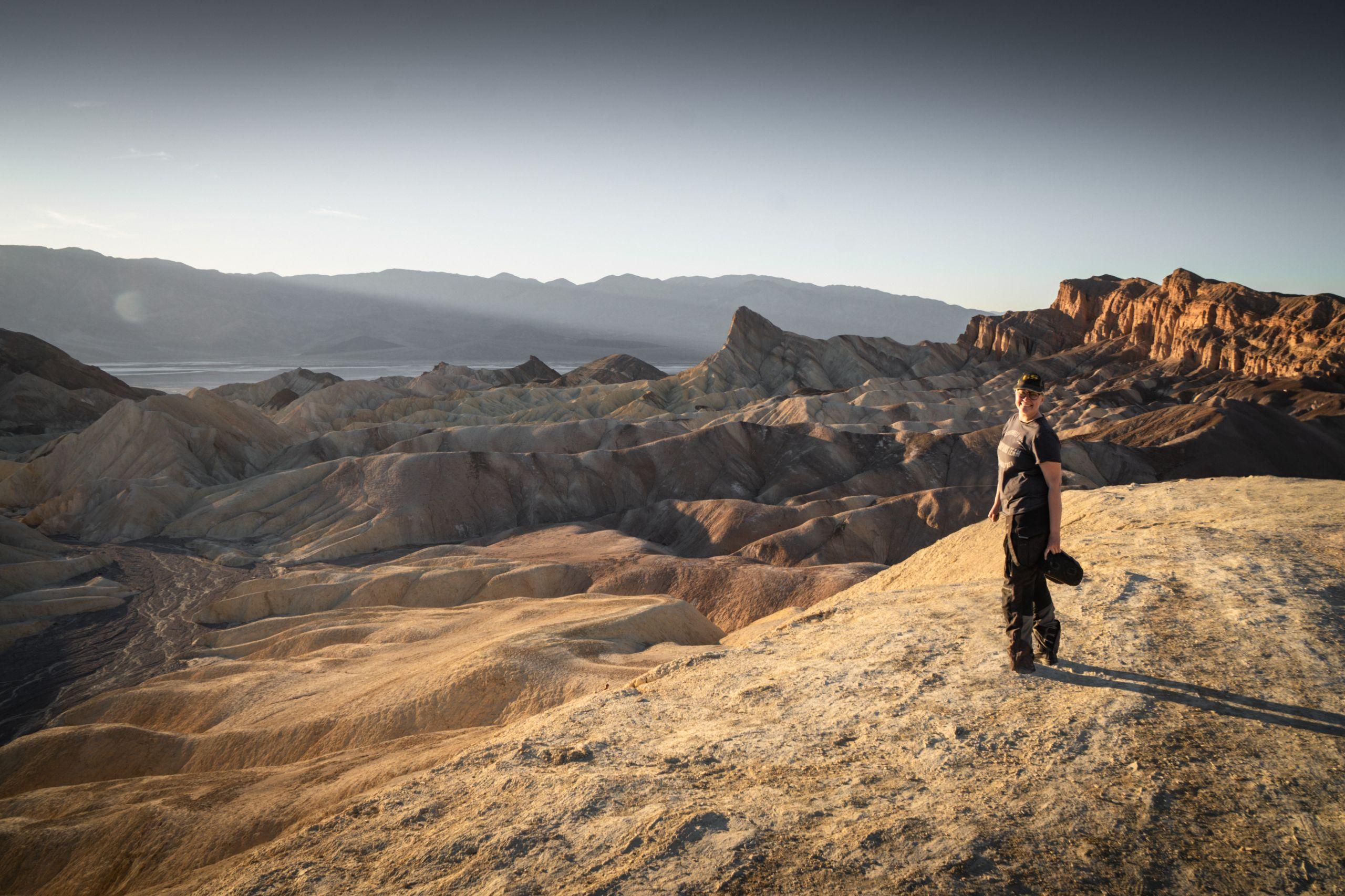
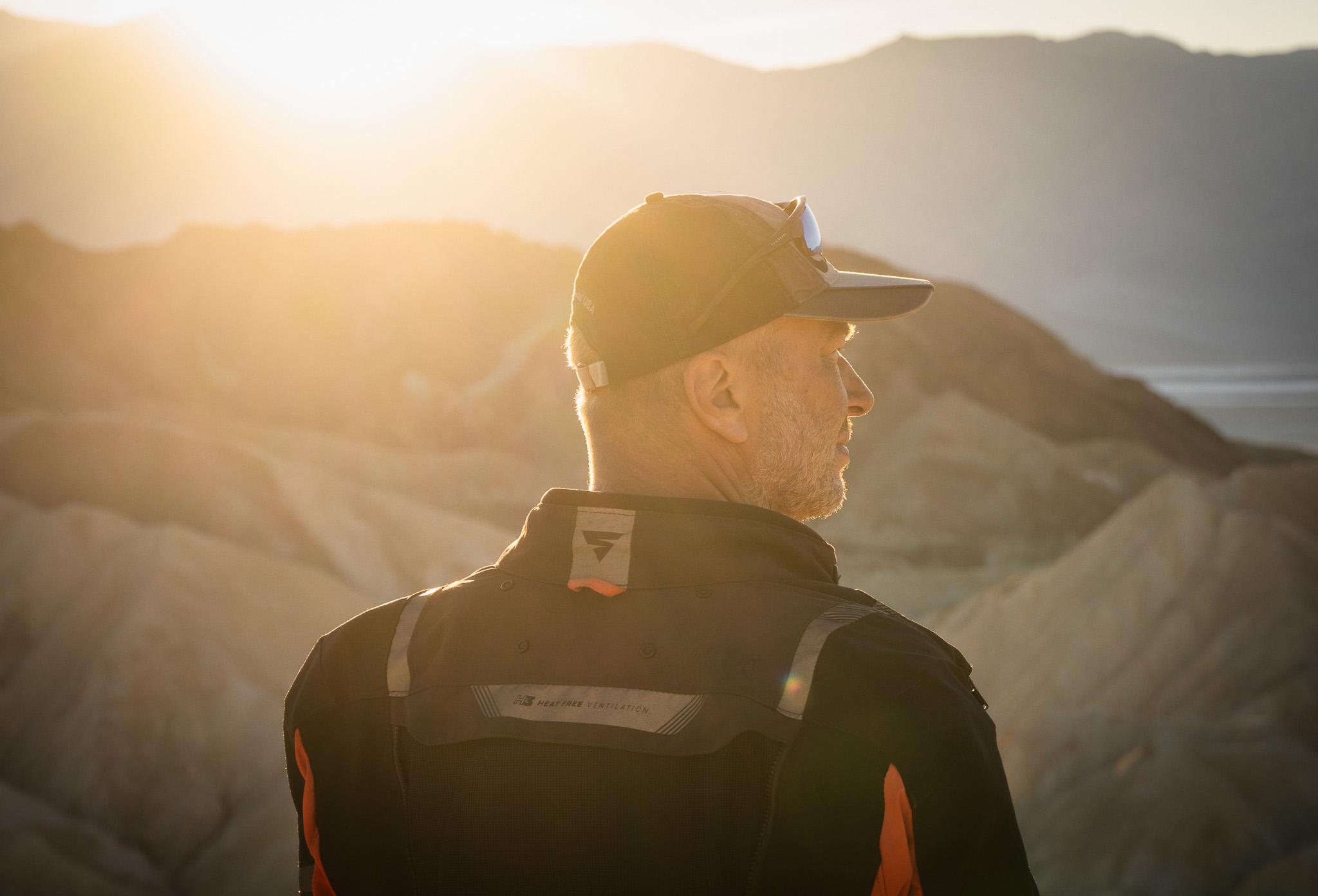
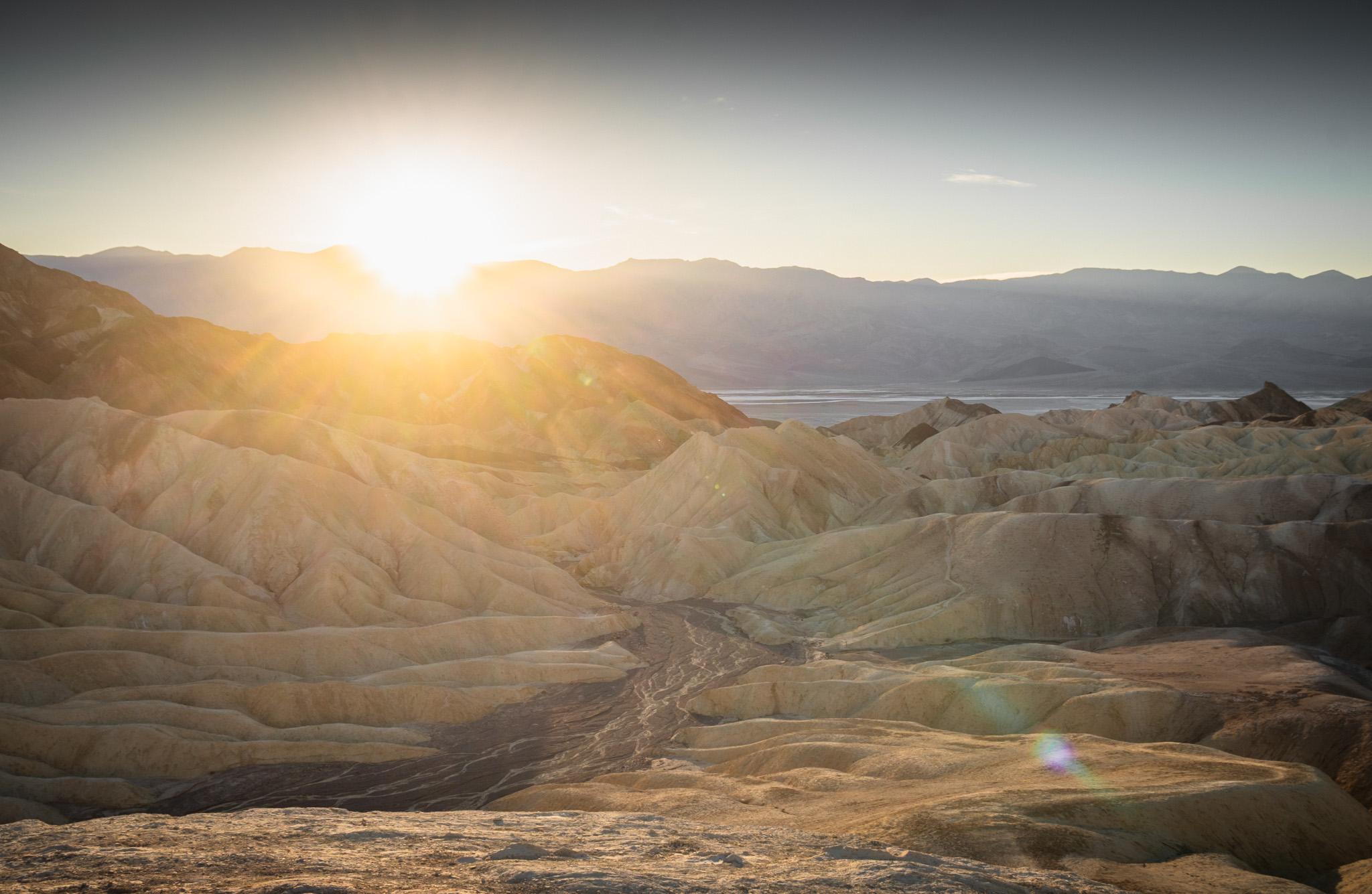
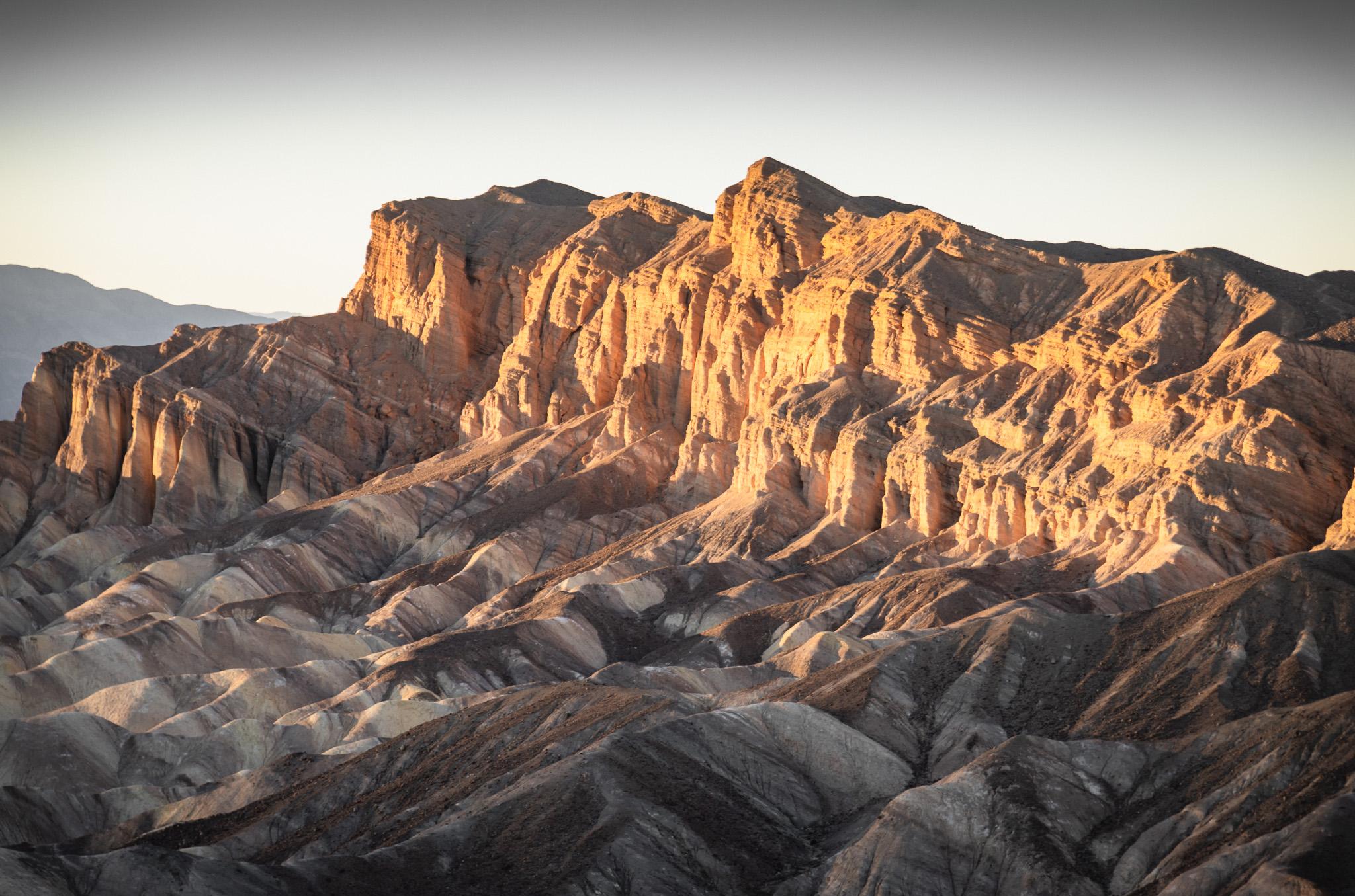
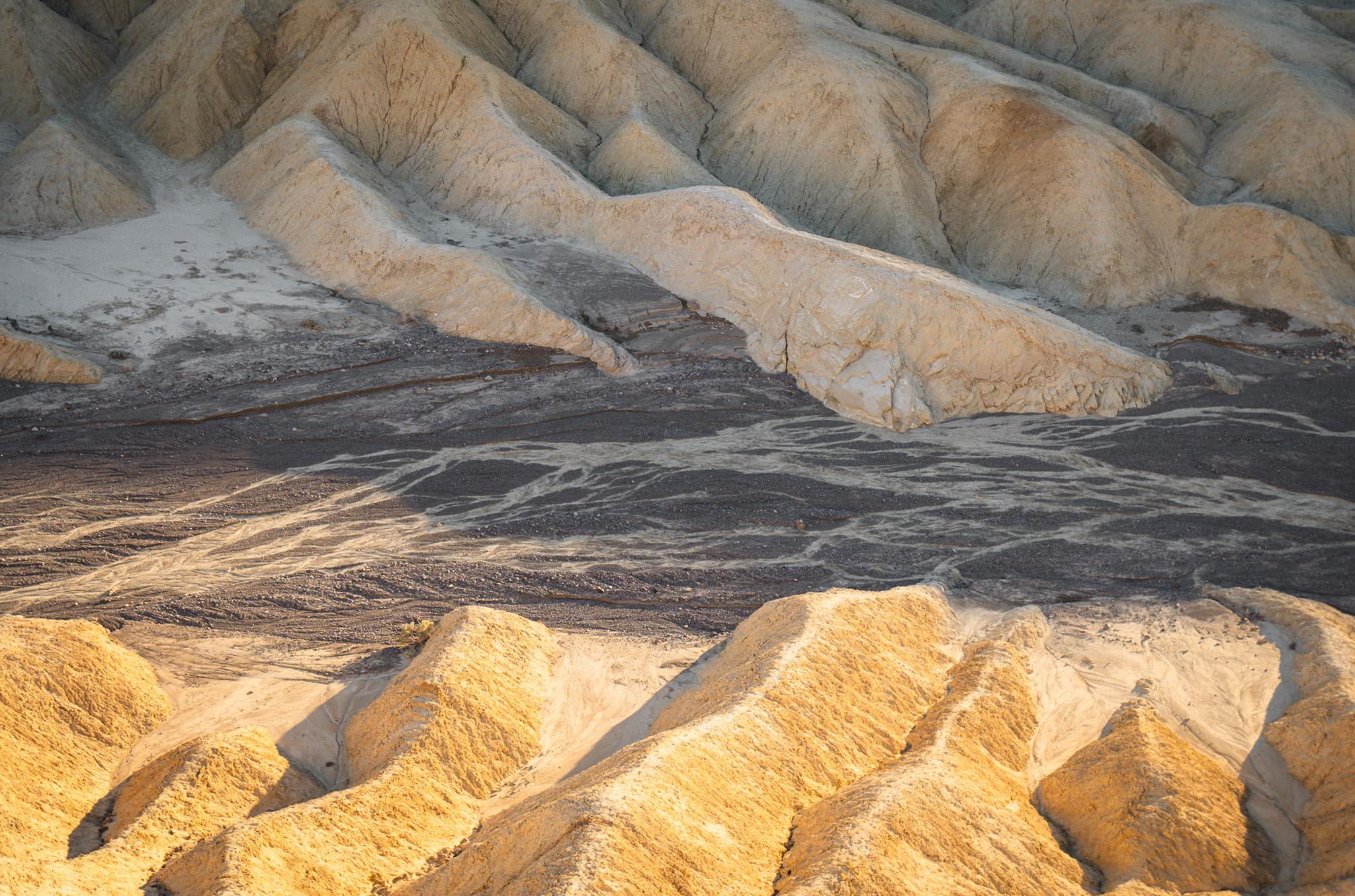
We couldn’t have imagined a more beautiful way to end the day. The light slowly softened, and the ravines and hills began to take on depth, losing all their harshness. For a moment, it seemed as though the desert was softening and letting us forget just how merciless it can be on a daily basis. Then the light faded, and the entire area was engulfed in the deep shadows of the approaching night.
MOTORCYCLING THROUGH DEATH VALLEY – BADWATER BASIN
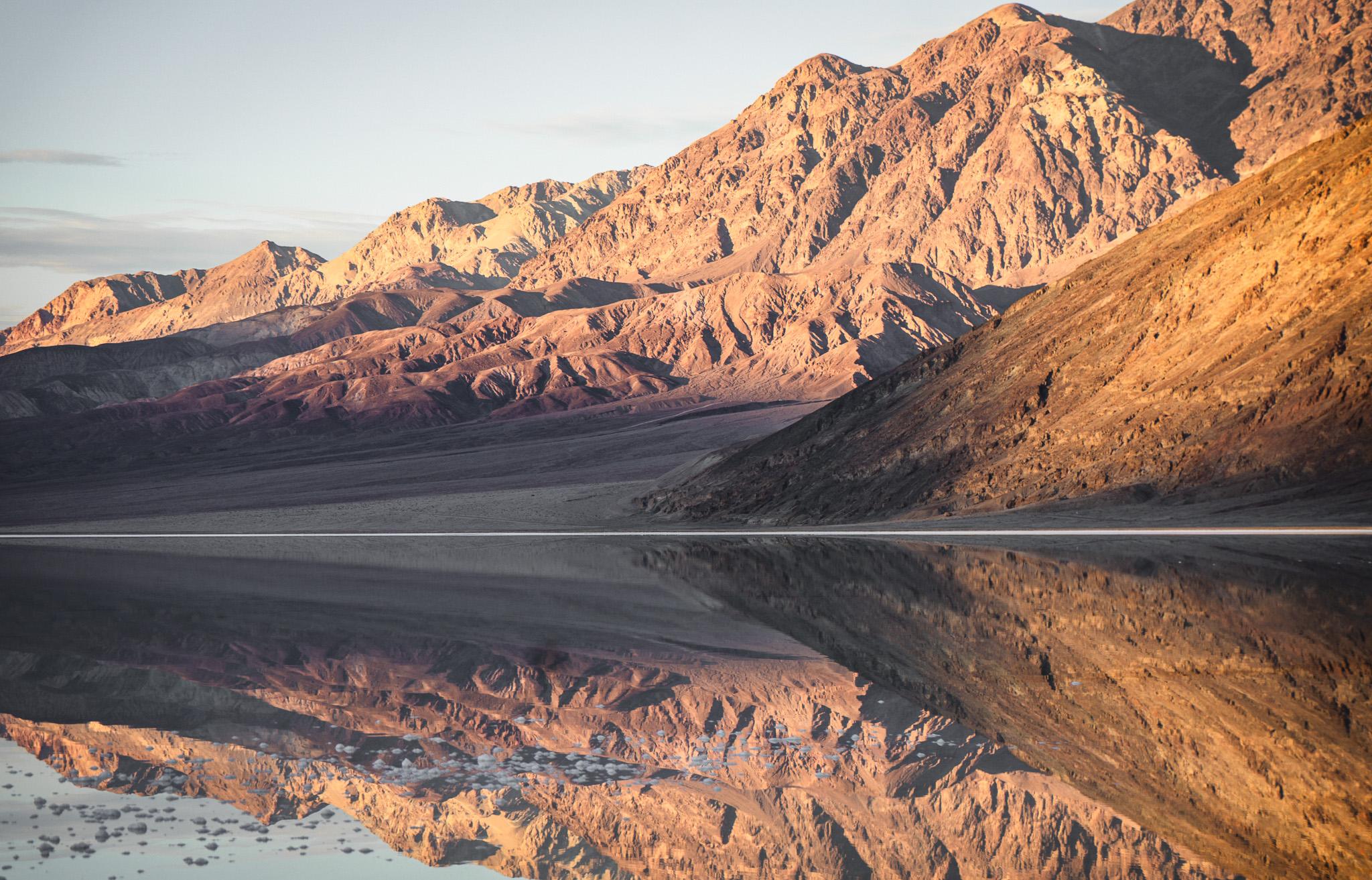
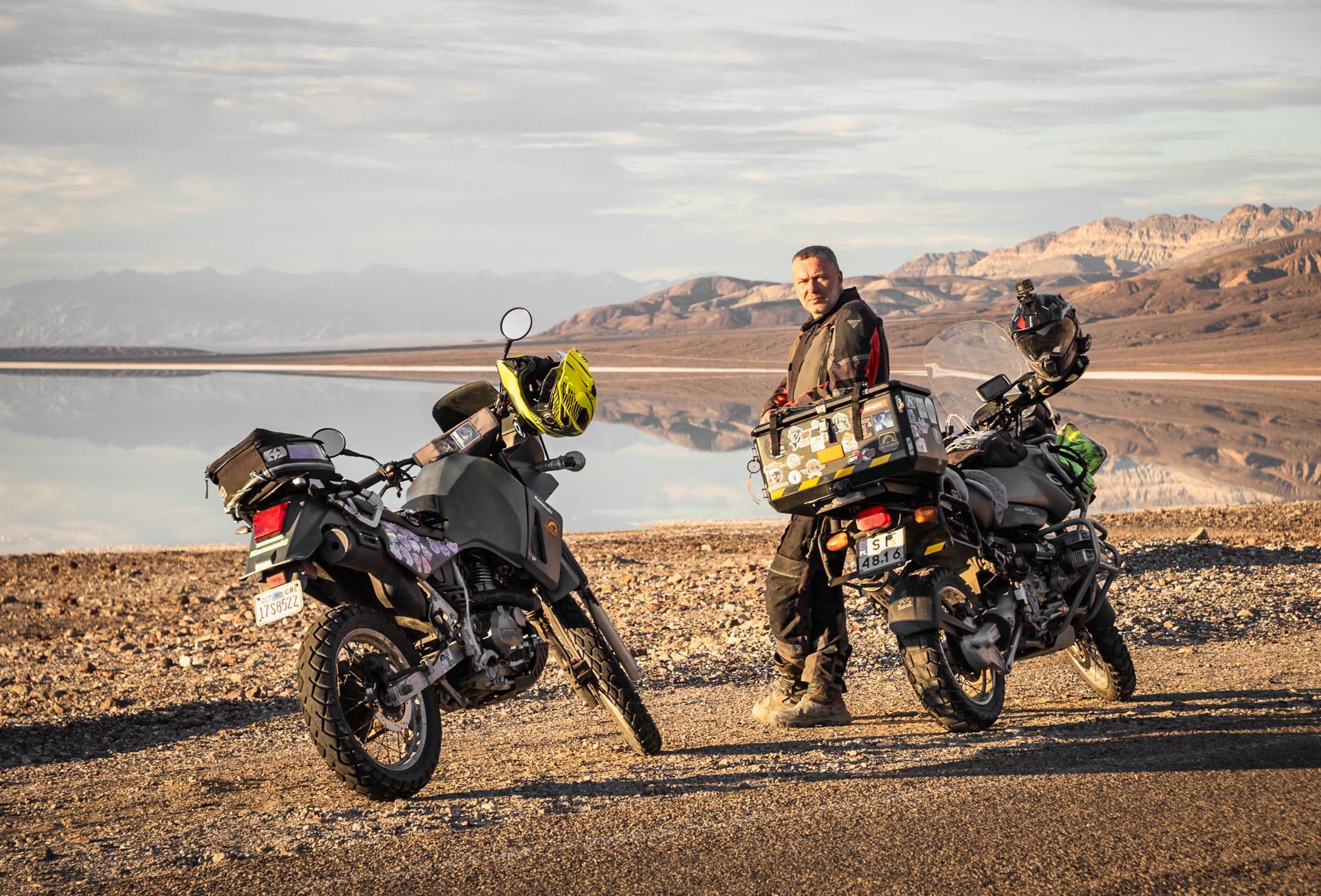
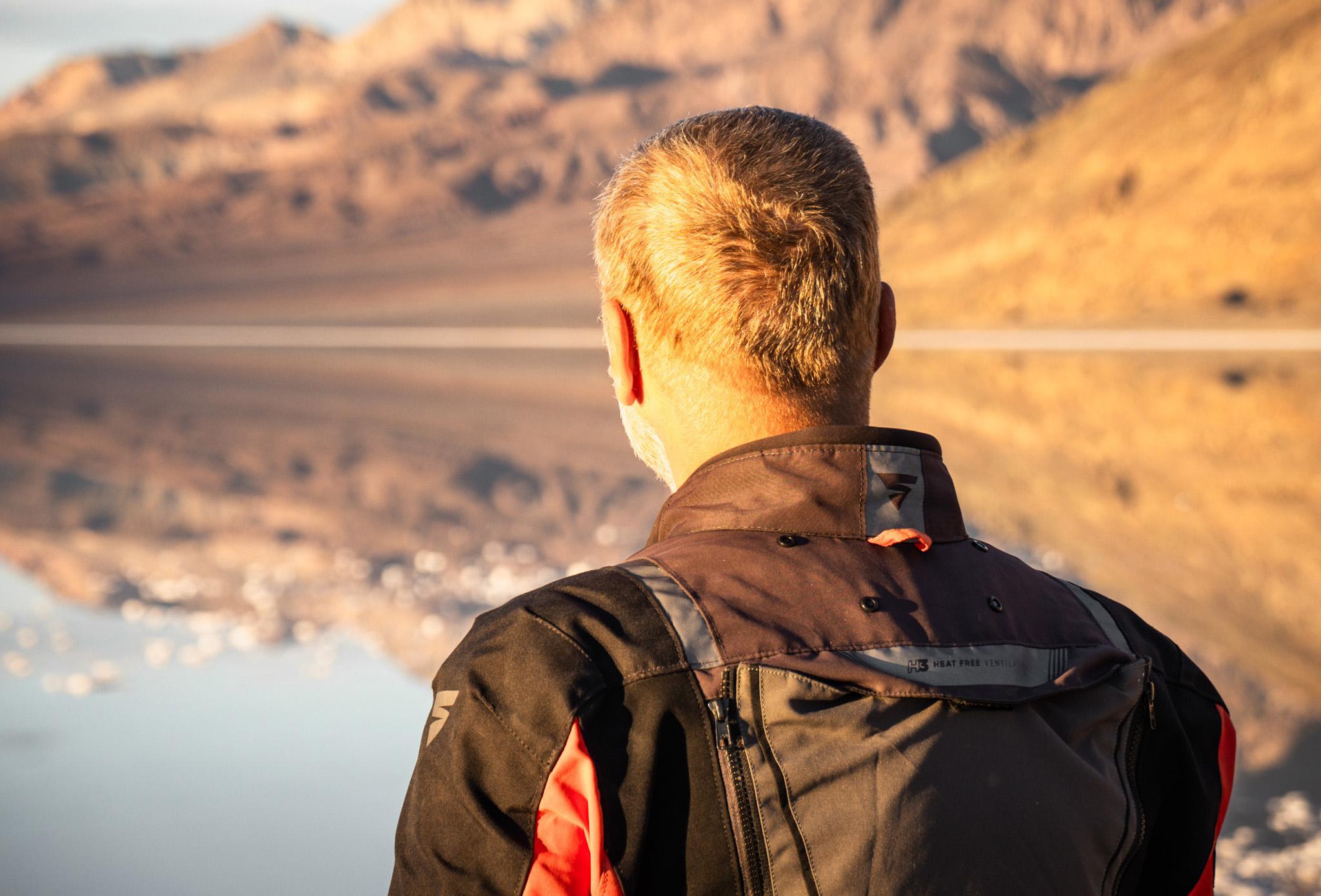
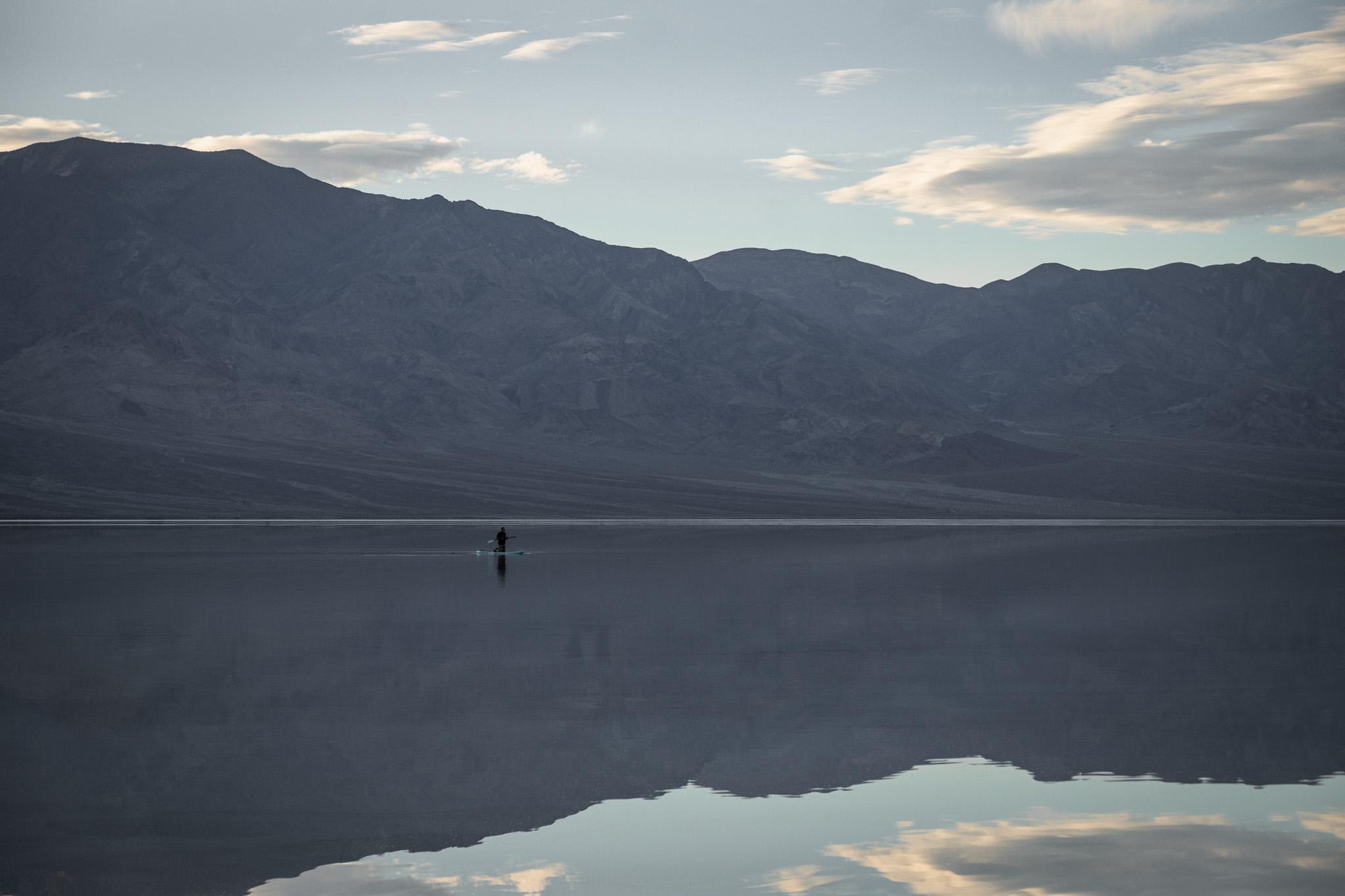
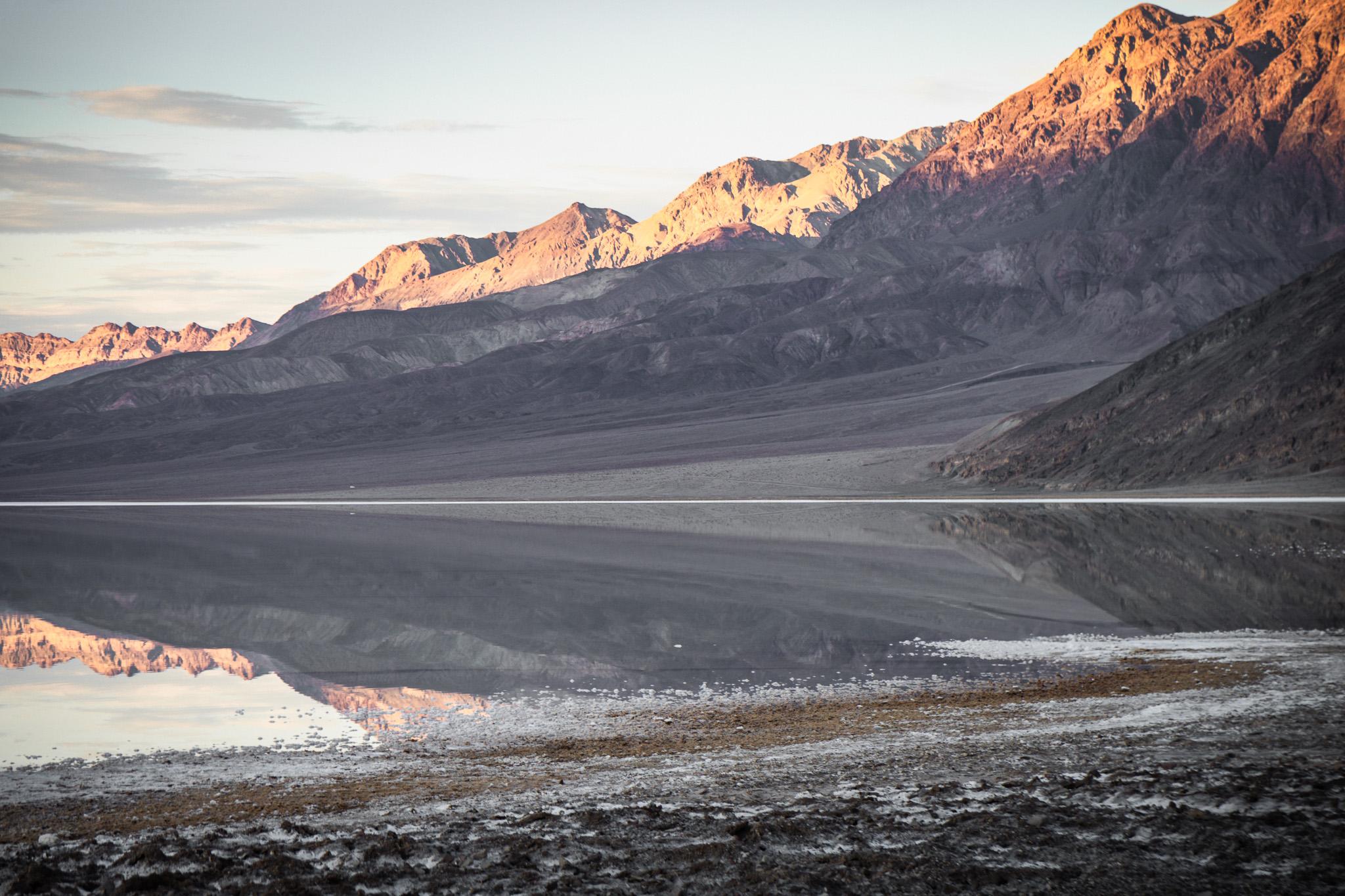
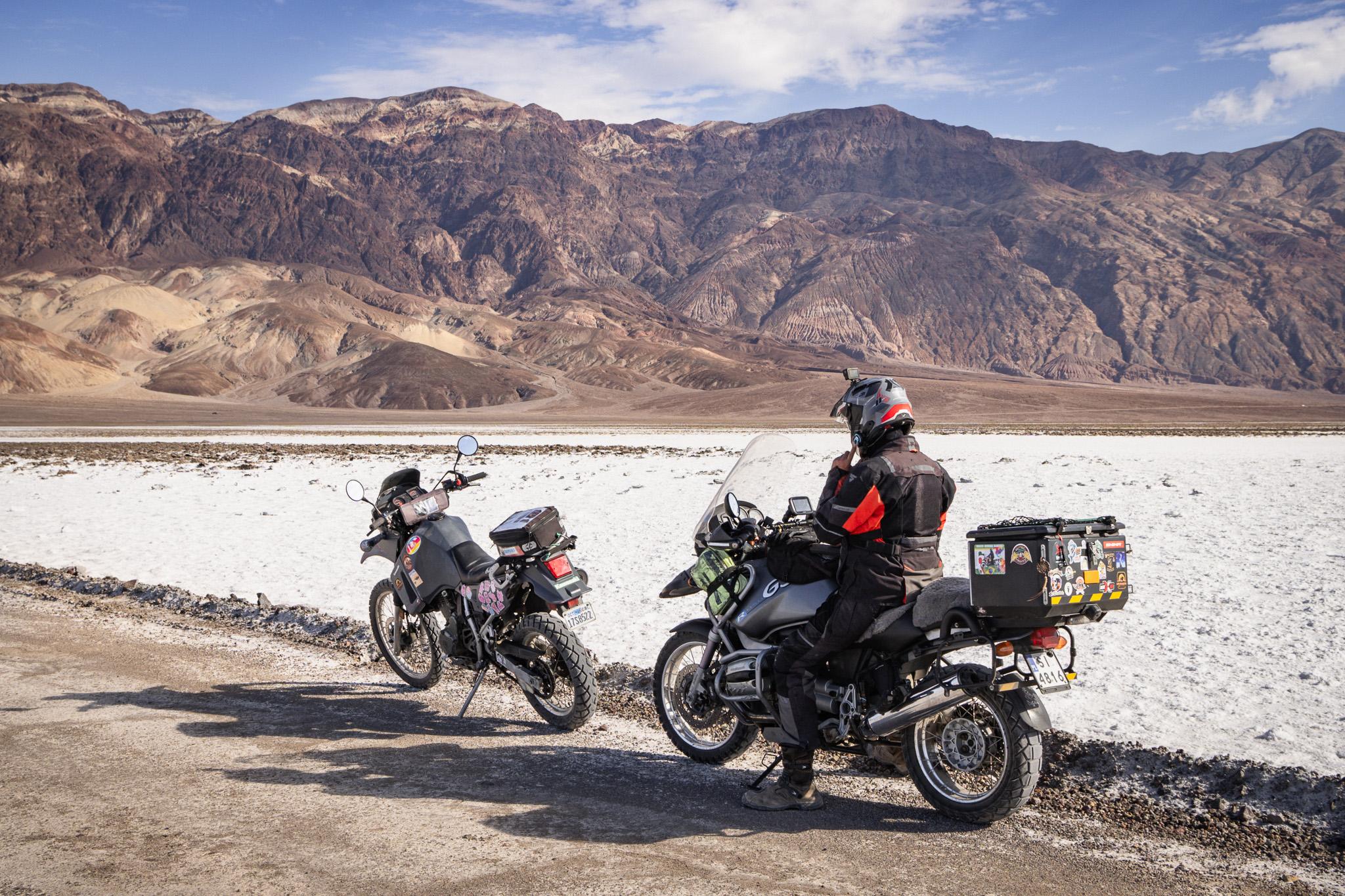
When we stood on the edge of Badwater the next day – the hottest and driest place in North America – we weren’t entirely sure we were in the right spot. In the photos we remembered from before the trip, Badwater Basin looked like a surreal salt desert stretching as far as the eye could see. Yet before us lay a pristine, almost motionless mirror of water, reflecting the intensely blue sky, spread across the surface as if glued to the ground. Badwater Basin had definitely ceased to look like the driest place in America.
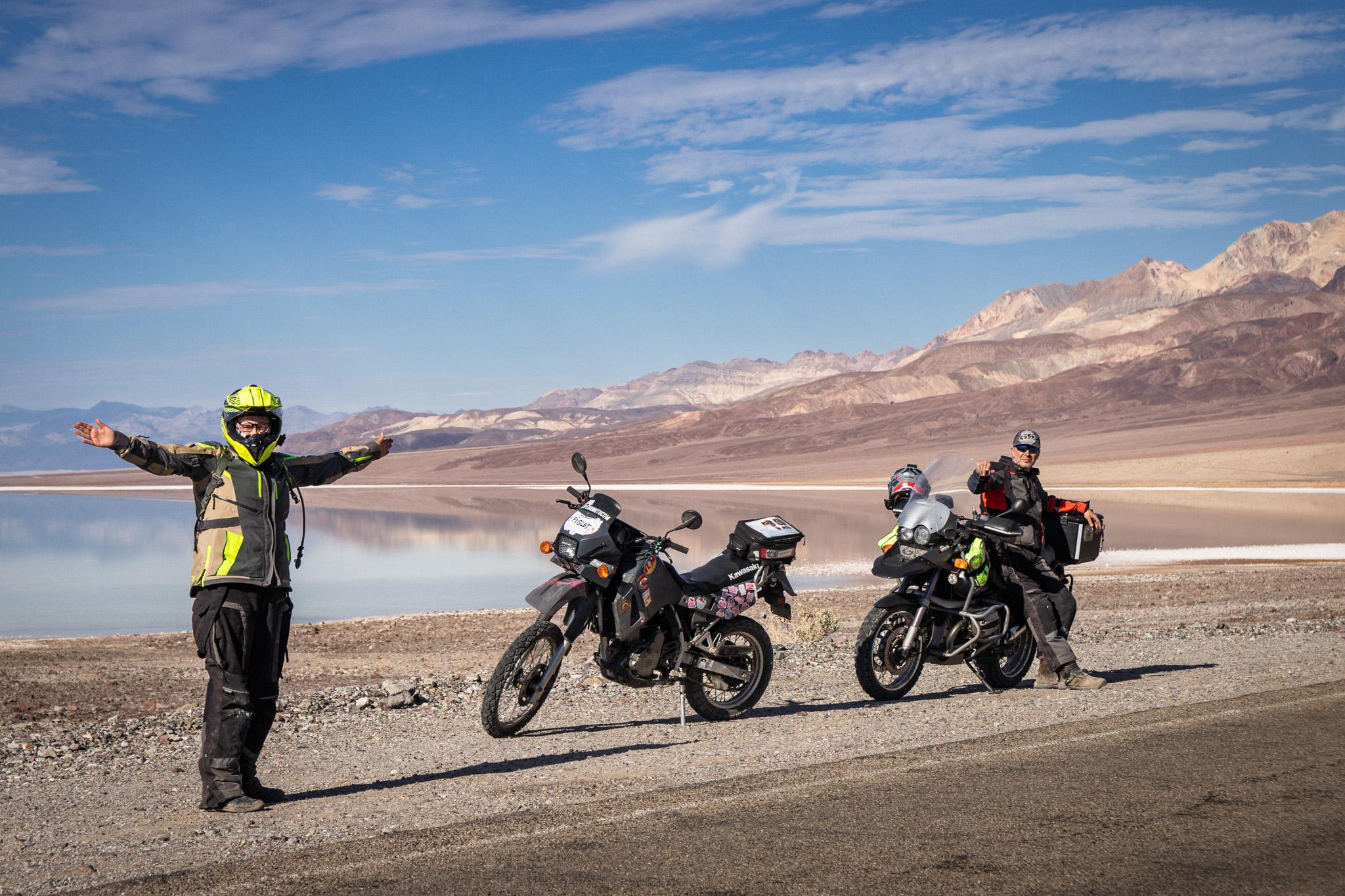
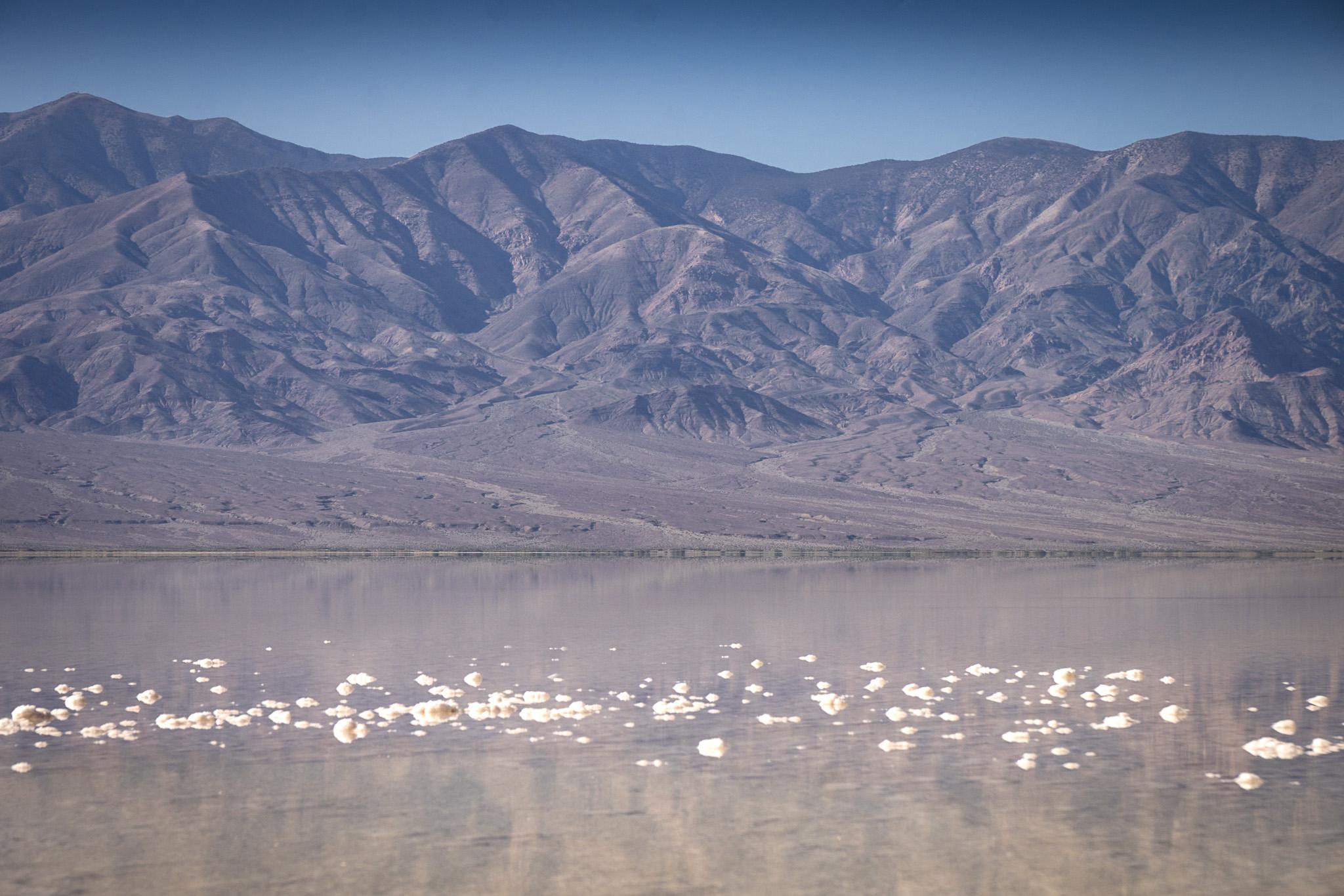
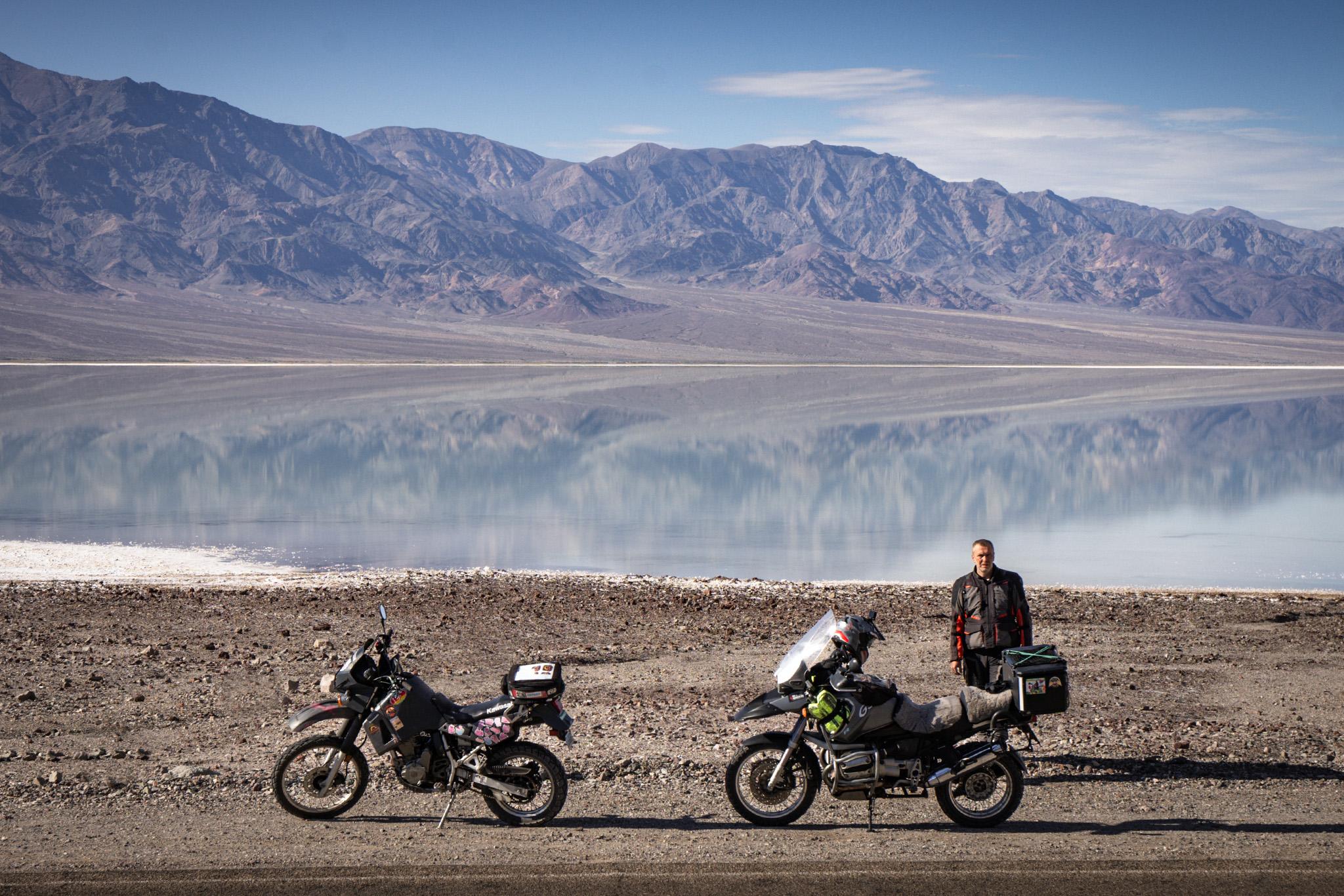
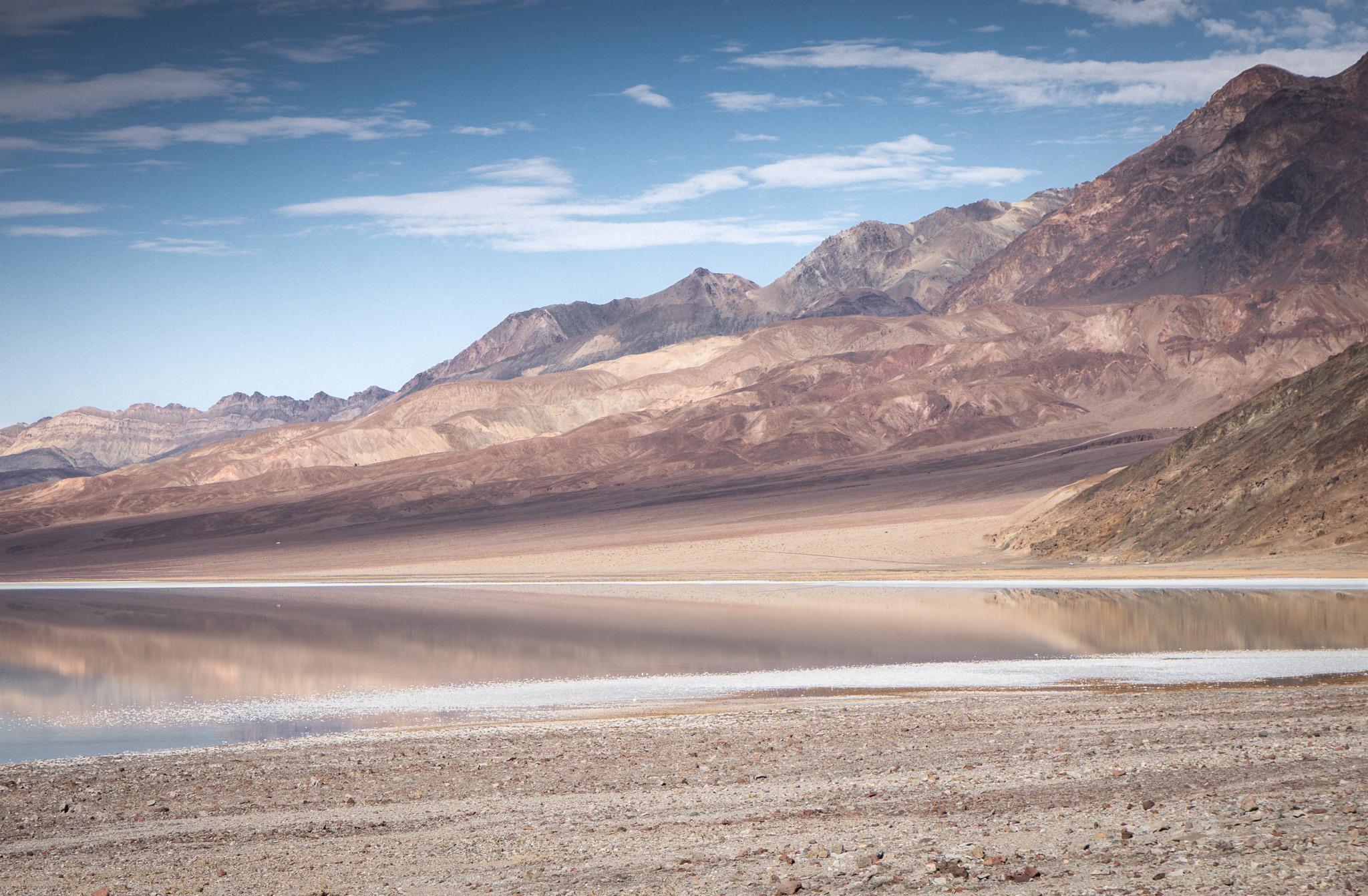
As we later learned, the lake was formed by unimaginable amounts of rain that fell in Death Valley. The day before, we had passed landslides, washed-out roads, and ravines carved out by rushing water – these were also the remnants of Hurricane Hilary. It was no wonder that Death Valley had been completely closed to tourists for a long time. And we couldn’t believe our luck that we were able to see with our own eyes not only the destruction but also the beauty that the hurricane left behind.
MOTORCYCLING THROUGH DEATH VALLEY – GOLDEN CANYON AND DEVIL’S GOLF COURSE
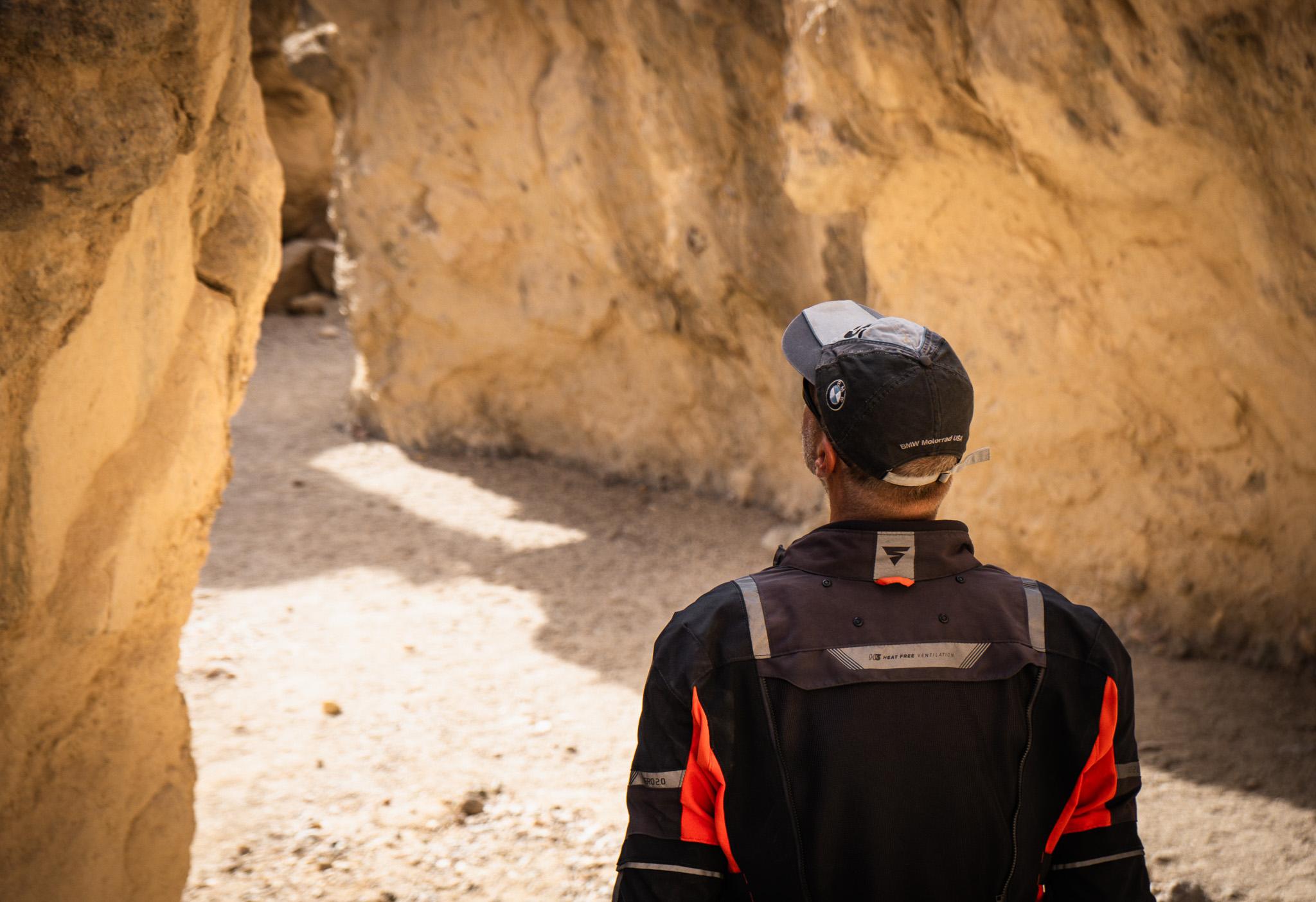
We had planned to stop at Golden Canyon just for a moment – it’s hard to explore in full sun while wearing motorcycle gear. But even the first few hundred meters of the trail, just past the entrance, looked so impressive that we decided to keep going. The golden, towering walls of the canyon formed a narrow corridor that slowly climbed upward. This trail was once the road connecting Badwater to Zabriskie Point. Traces of it are still visible in places – fragments of flat concrete slabs contrast with the rugged rocks of the canyon.
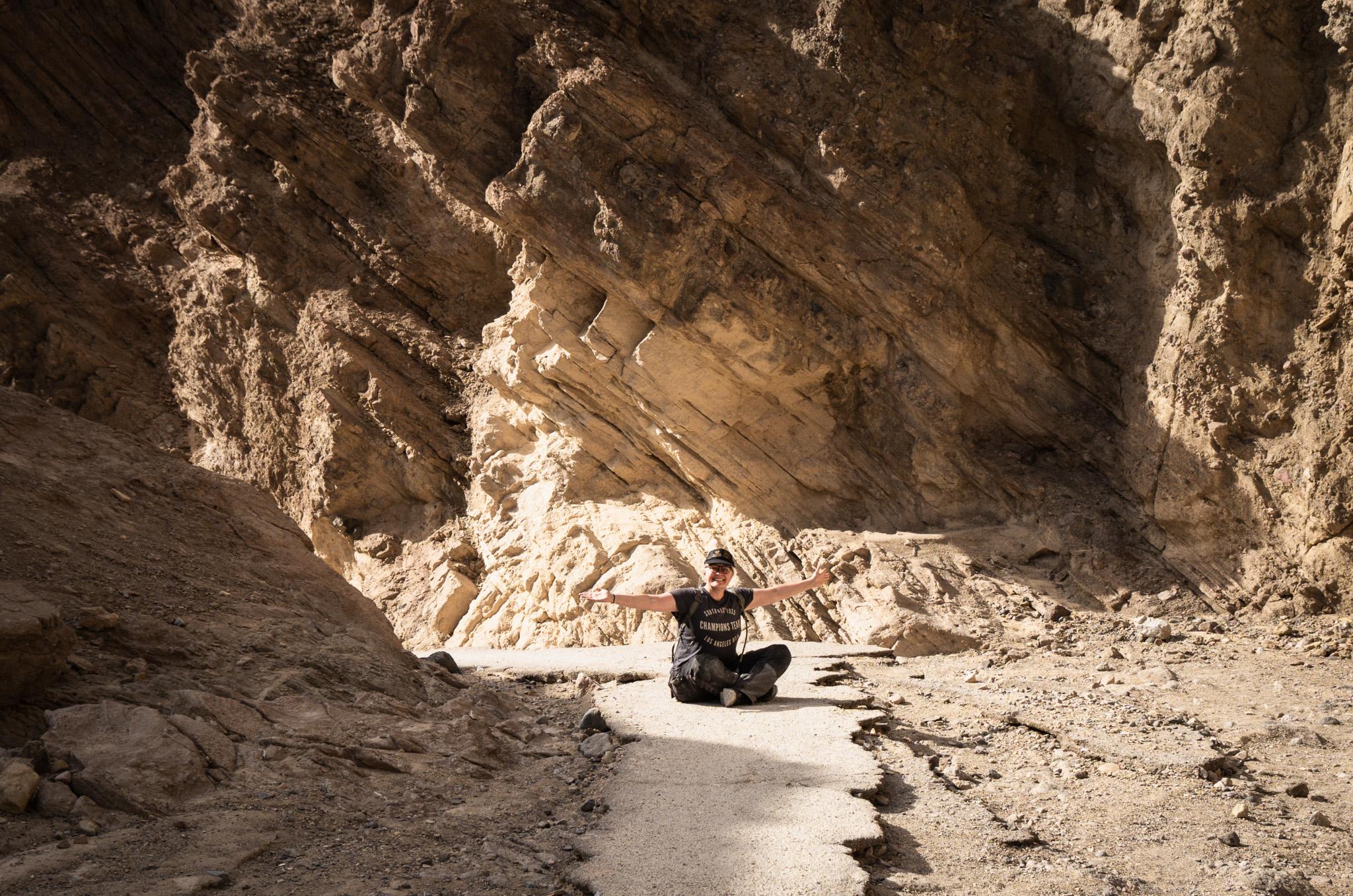
This is one of those landscapes where it’s easy to appreciate the sheer power of nature. In 1976, severe weather literally washed away the road that used to run here, leaving only fragments and traces of its former route. Today, only a hiking trail runs through here, continuing toward Red Cathedral – a massive, reddish rock formation resembling a Gothic cathedral. The route also branches off toward Zabriskie Point, from where we had observed this very same landscape from above the day before.
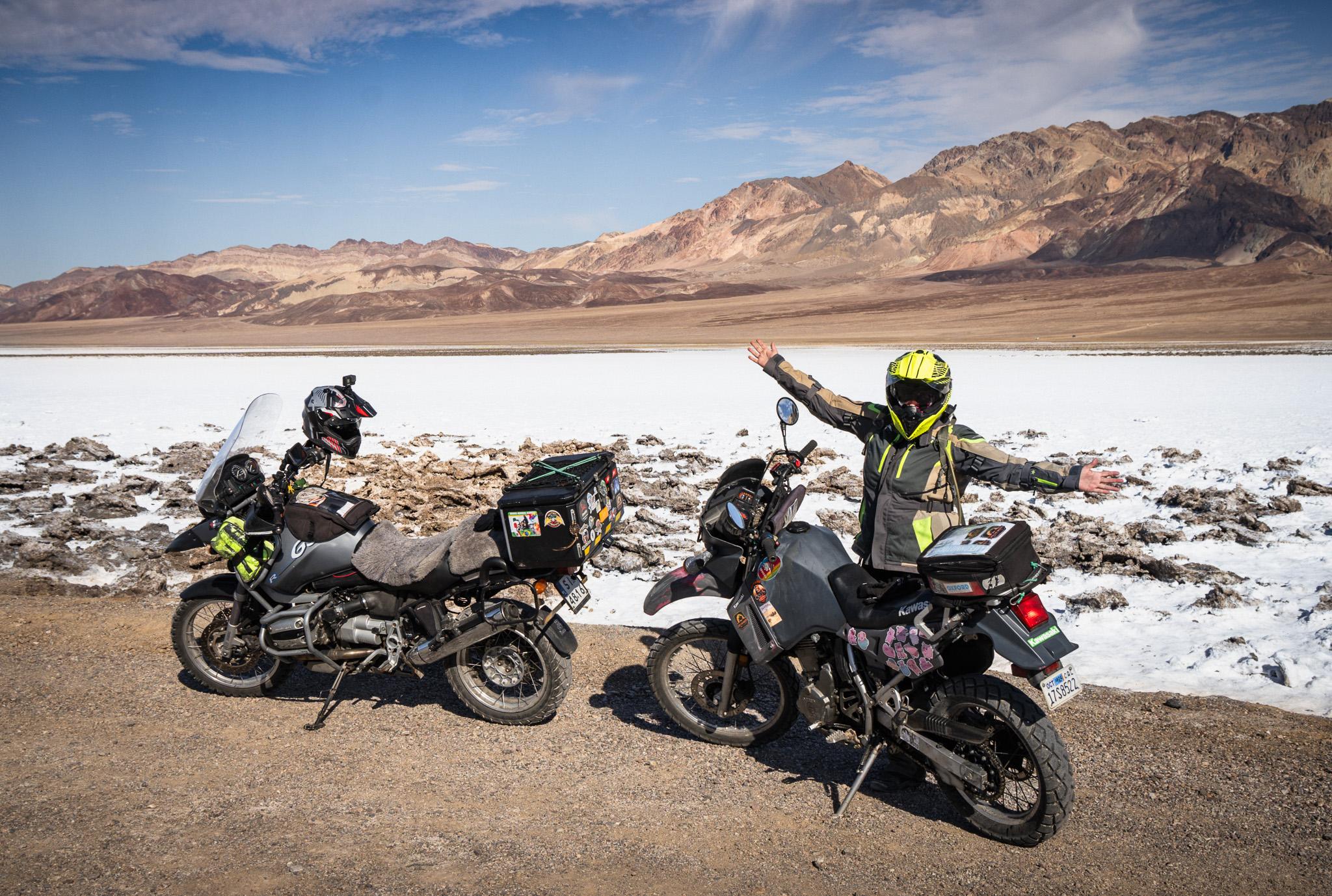
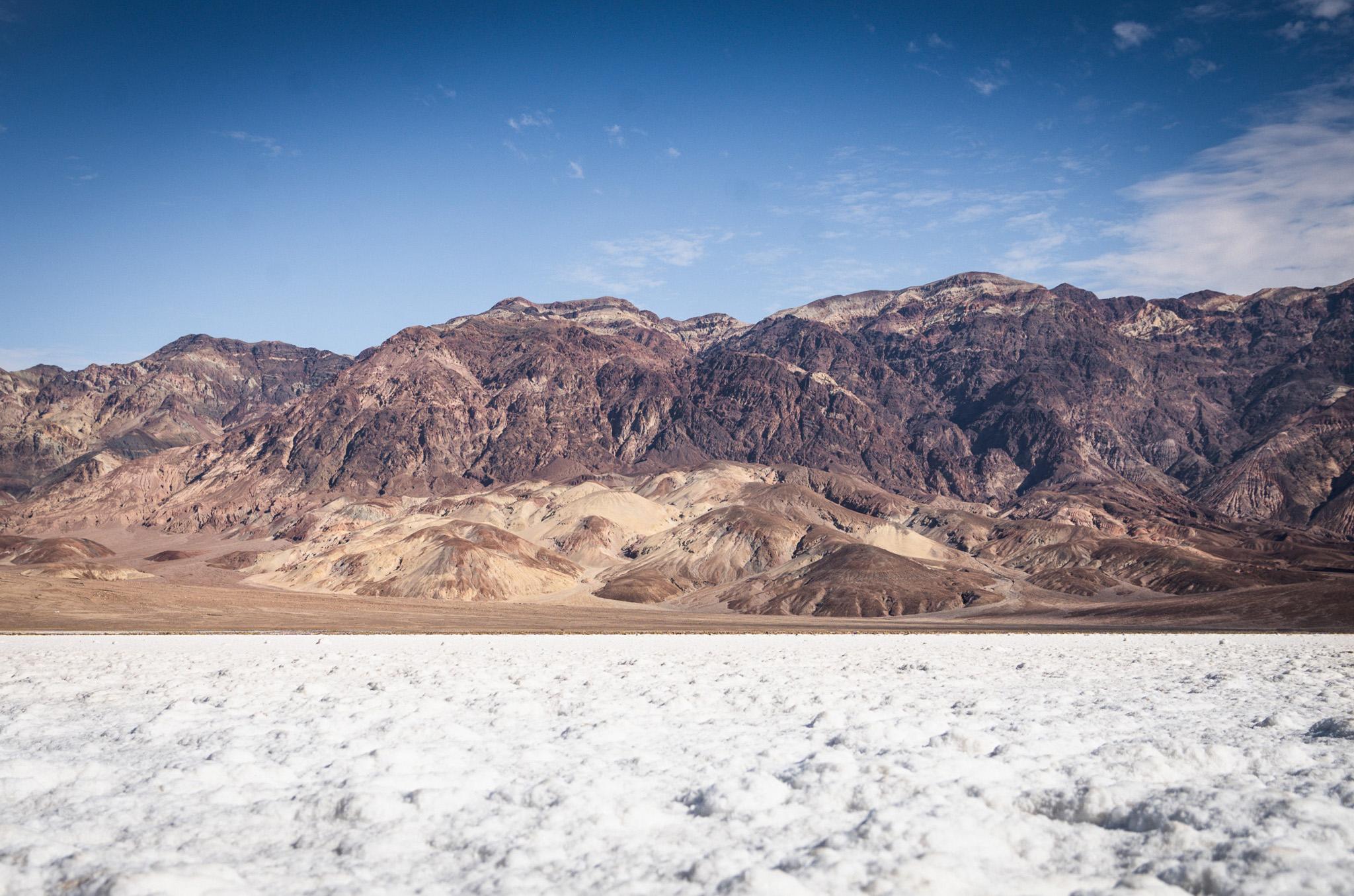
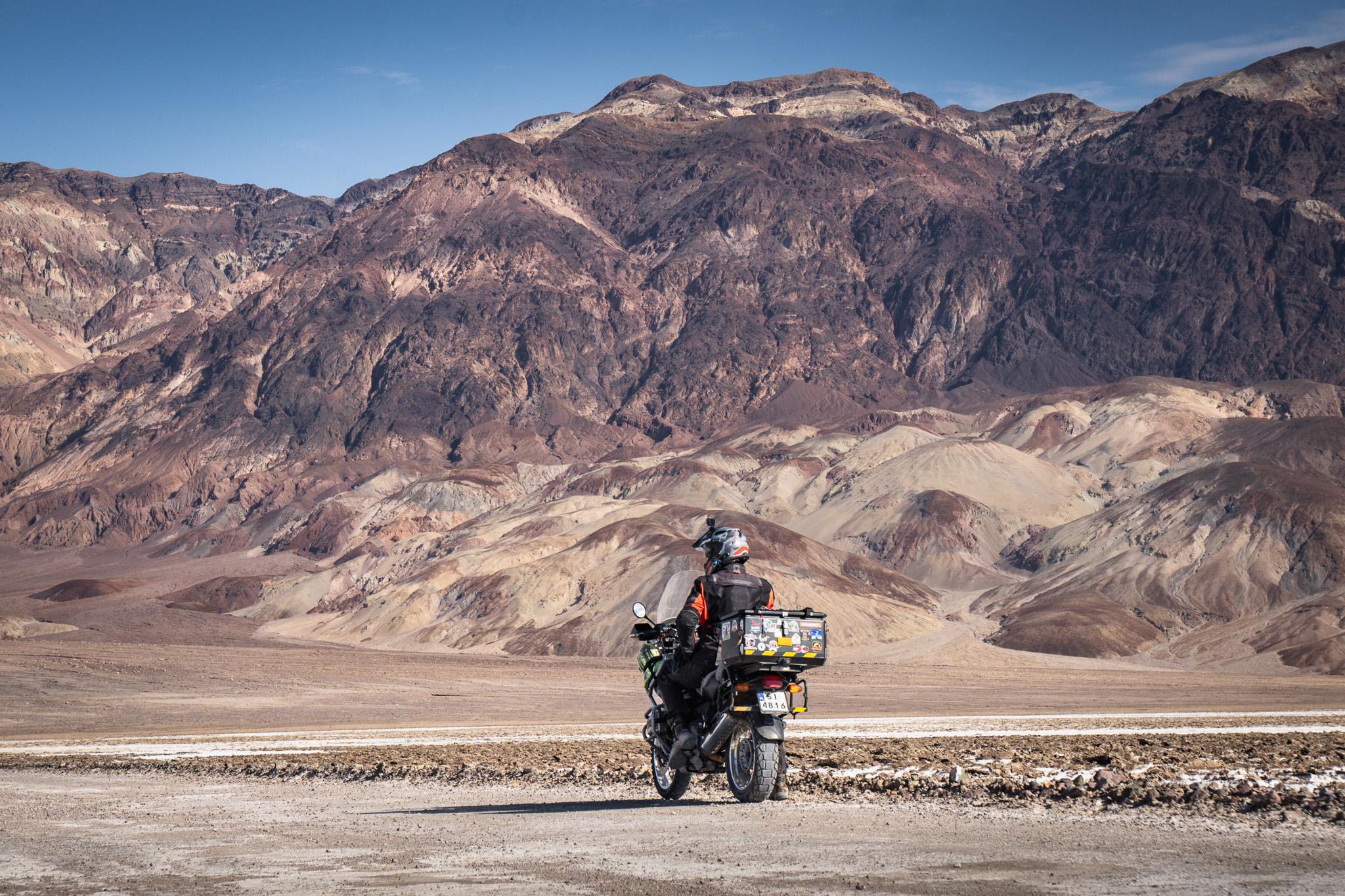
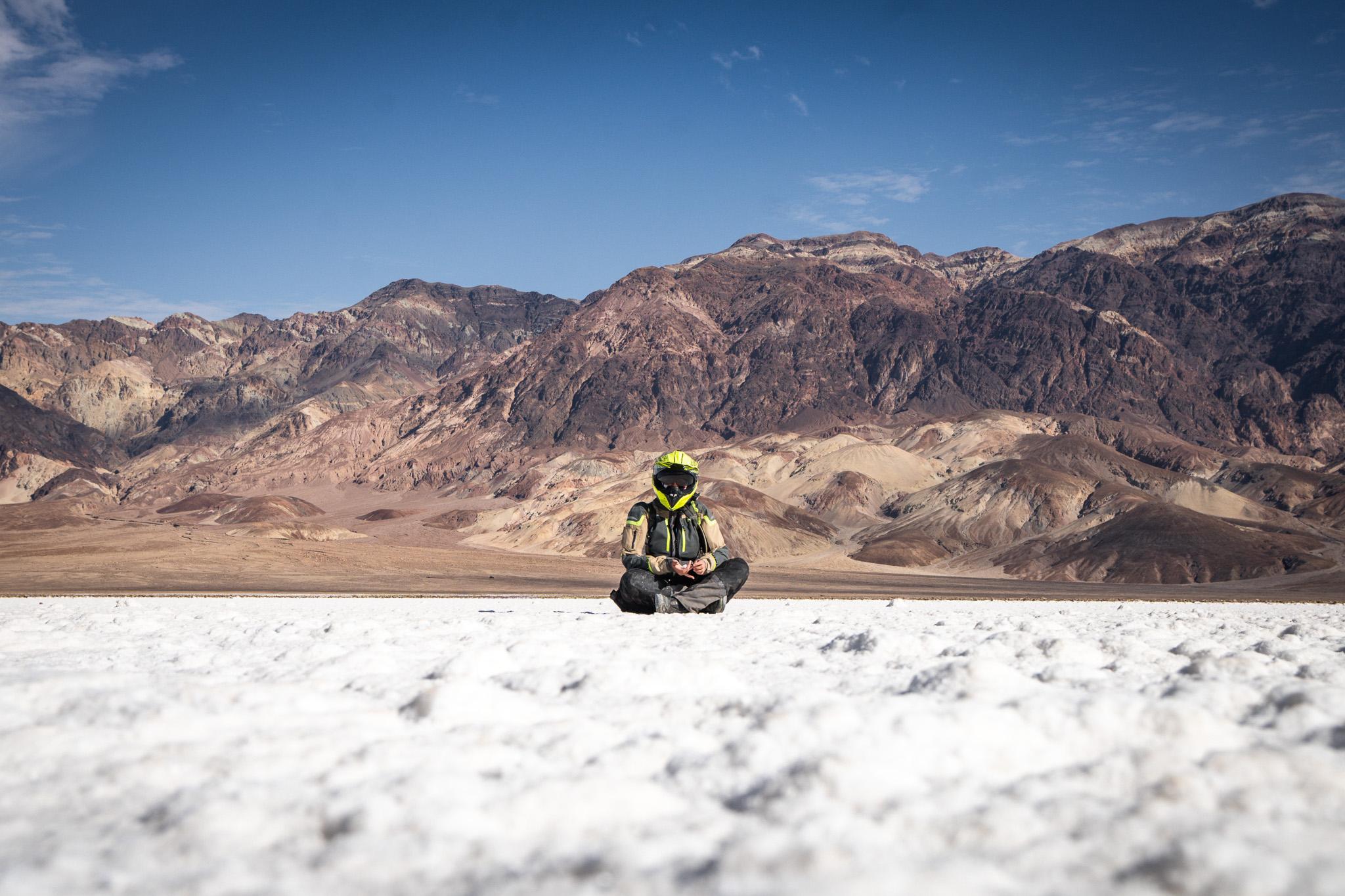
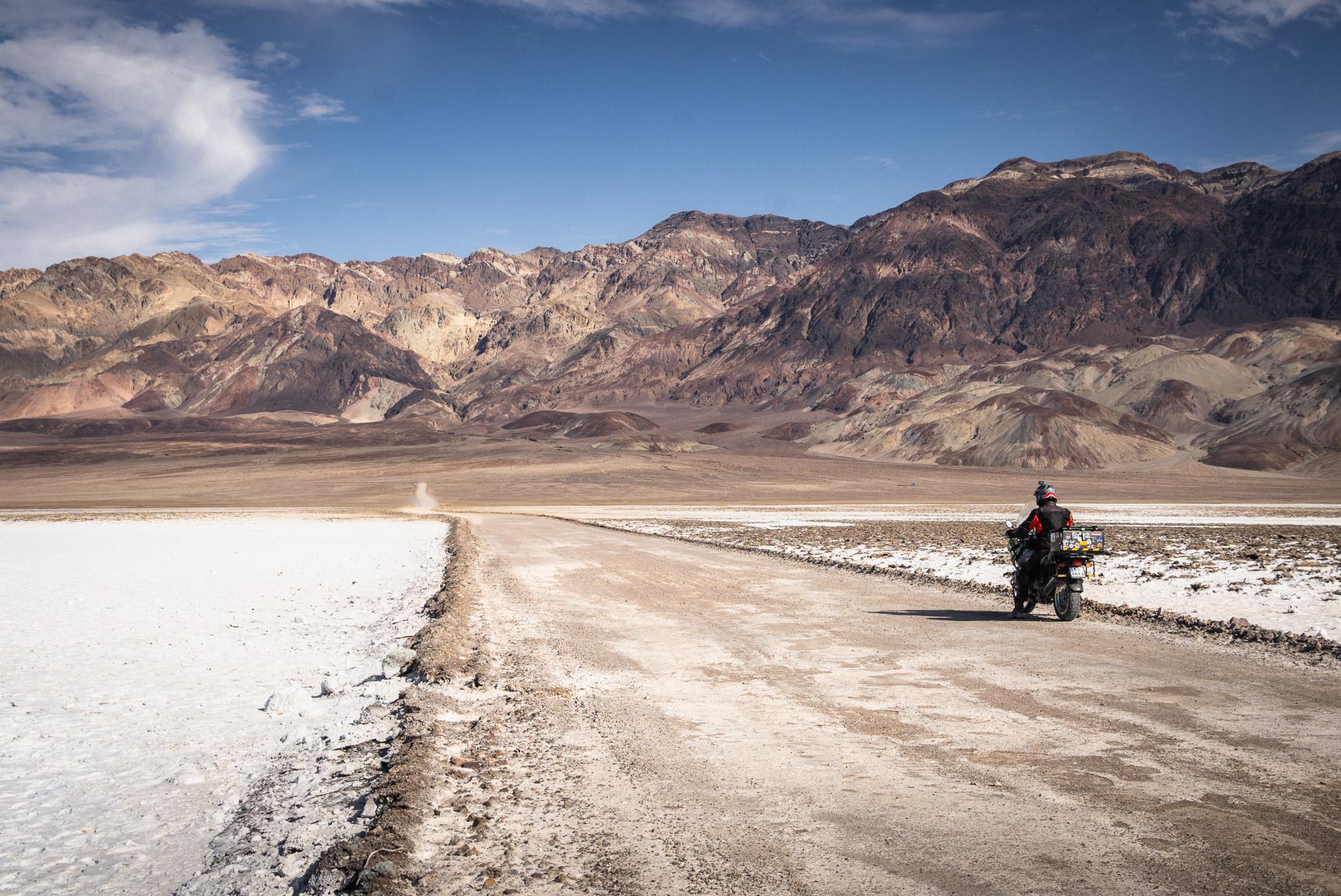
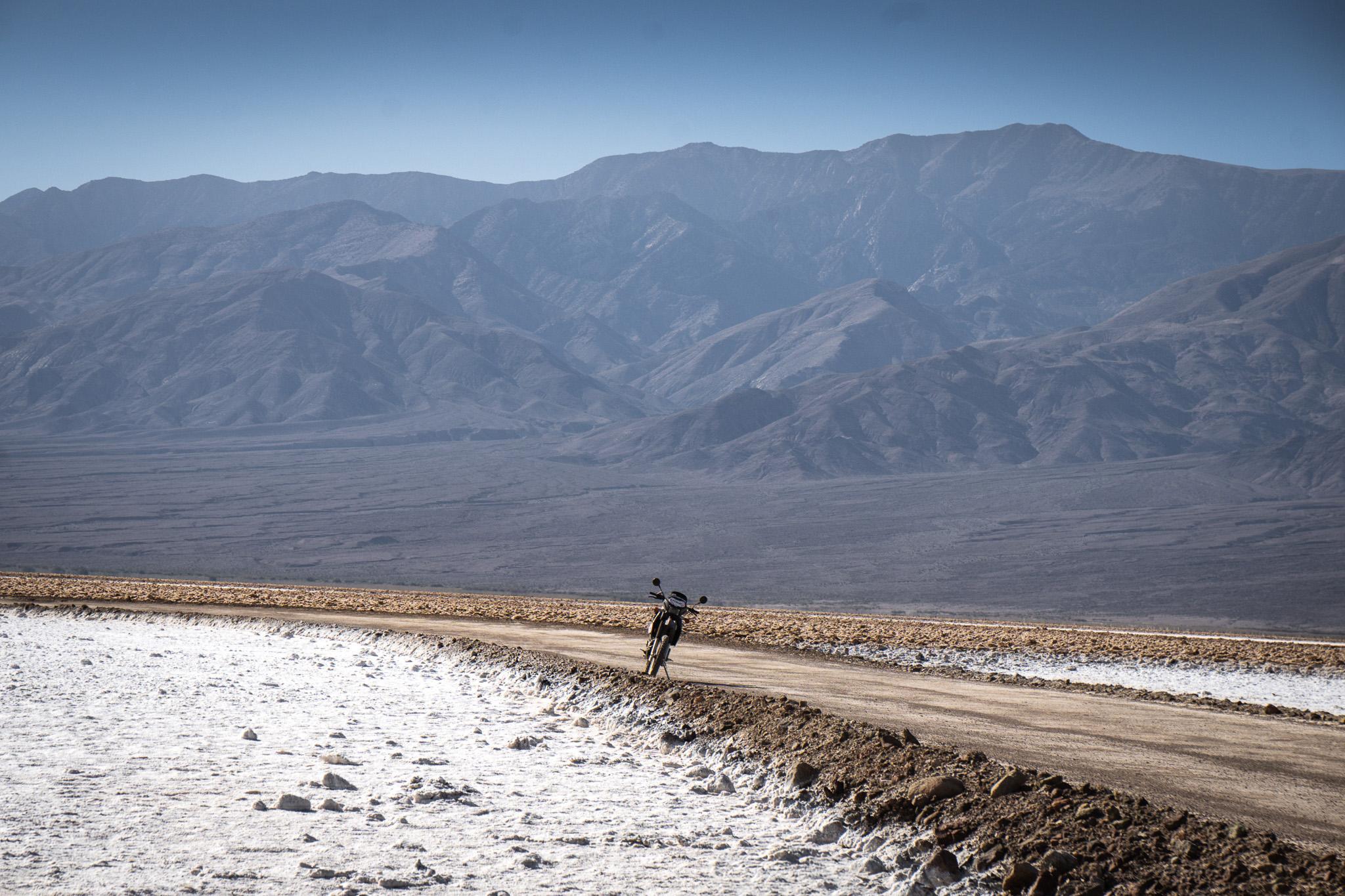
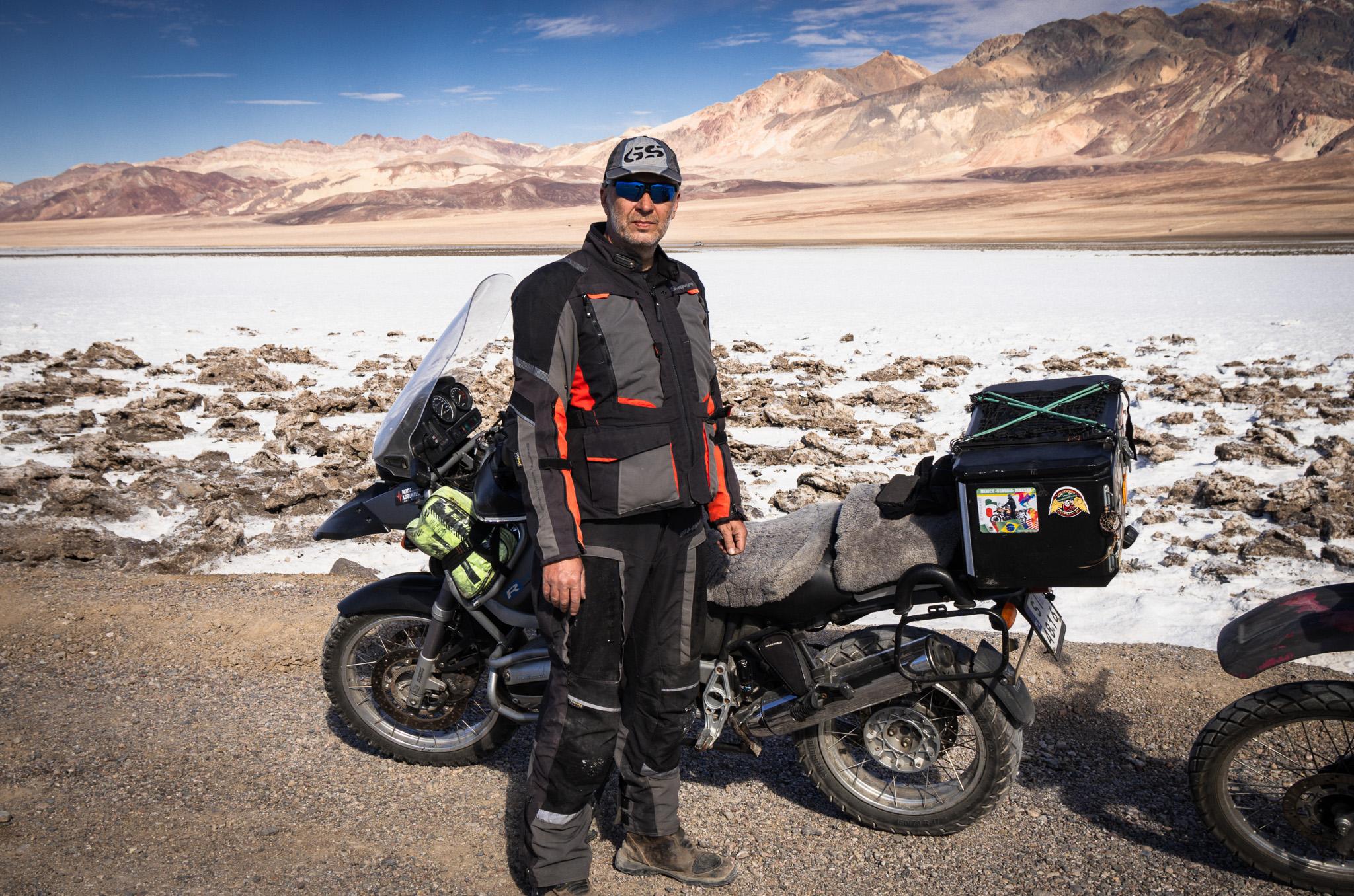
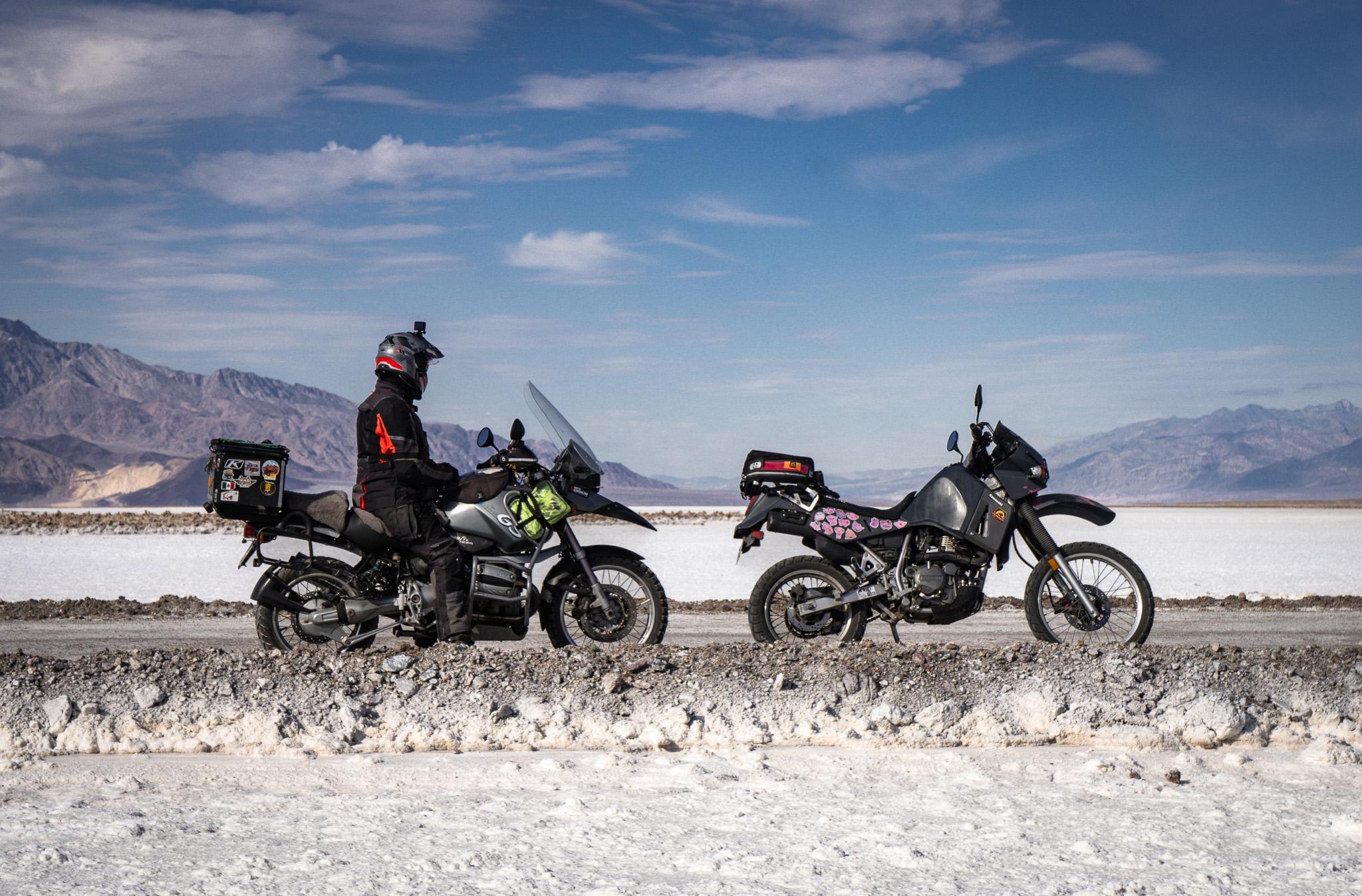
While Golden Canyon lies right next to the main paved road cutting through Death Valley, Devil’s Golf Course could only be reached via a gravel road that cut straight across the valley. Devil’s Golf Course, like Badwater, is located on the site of a former salt lake that once filled the entire Death Valley. The water evaporated over thousands of years, leaving behind thick layers of salt. Today, they form a landscape reminiscent of an alien planet – an endless expanse of sharp, jagged salt formations stretching to the horizon, creating a uniform, almost unbroken white surface.
MOTORCYCLING THROUGH DEATH VALLEY – PANAMINT SPRINGS
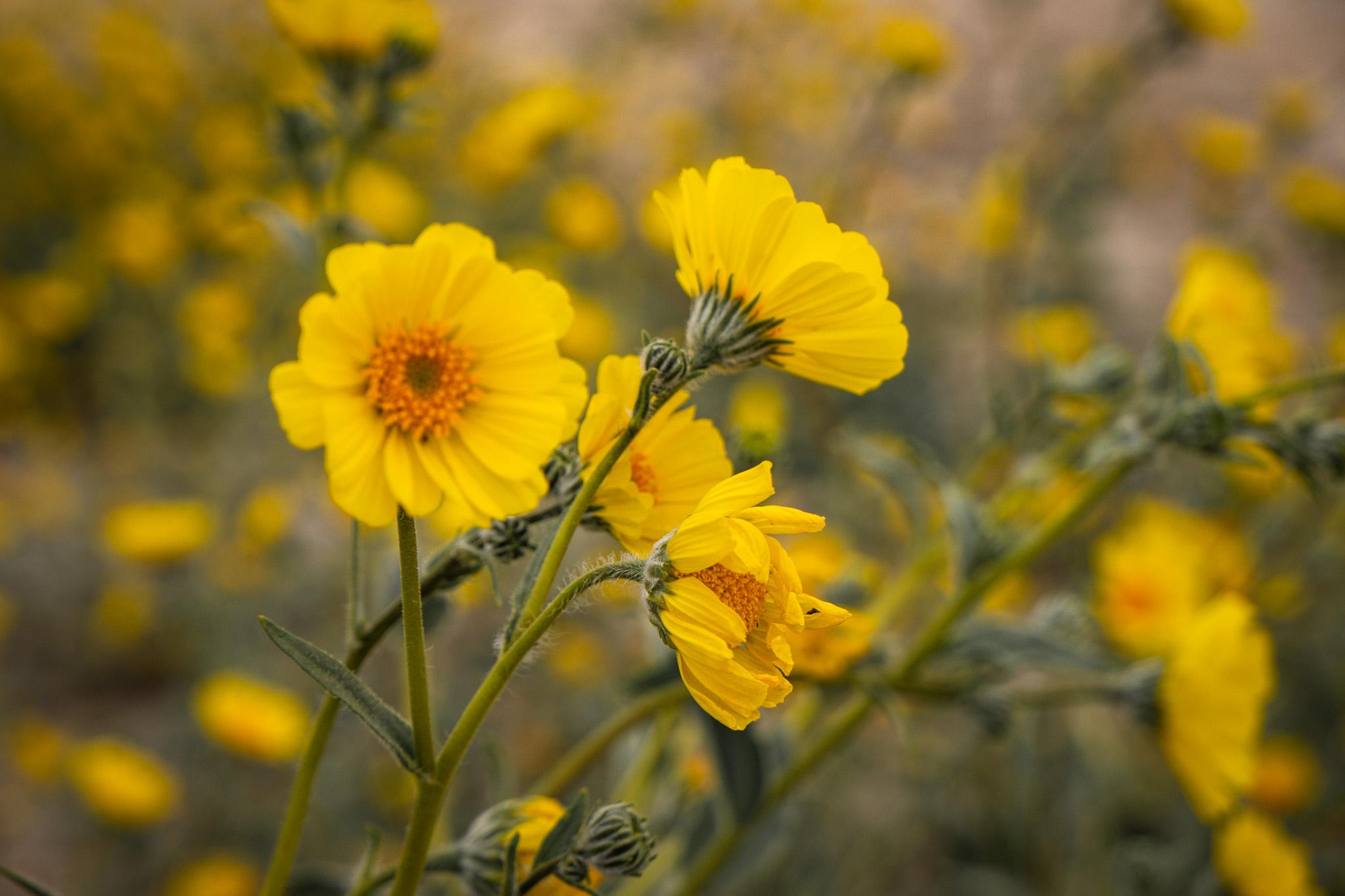
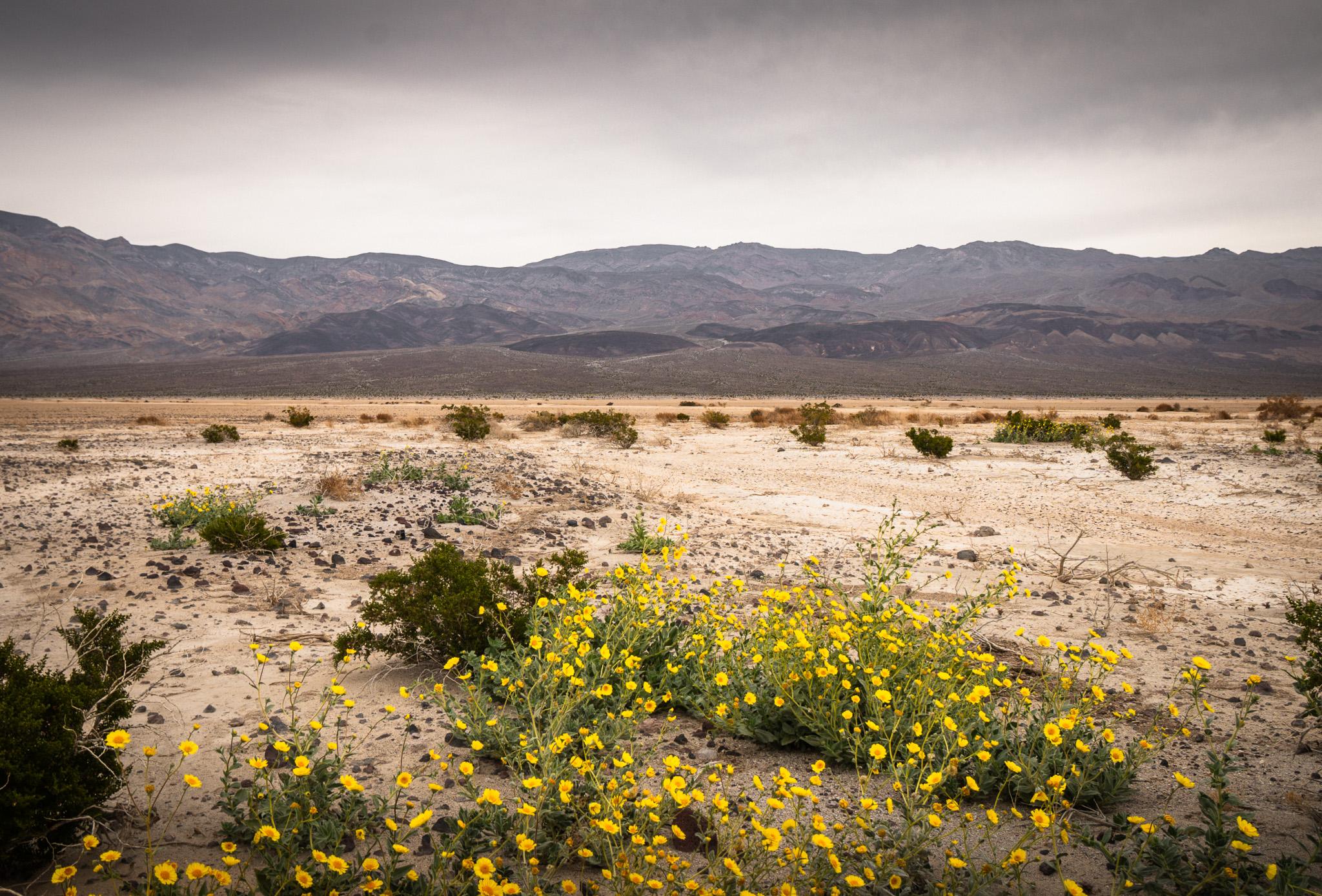
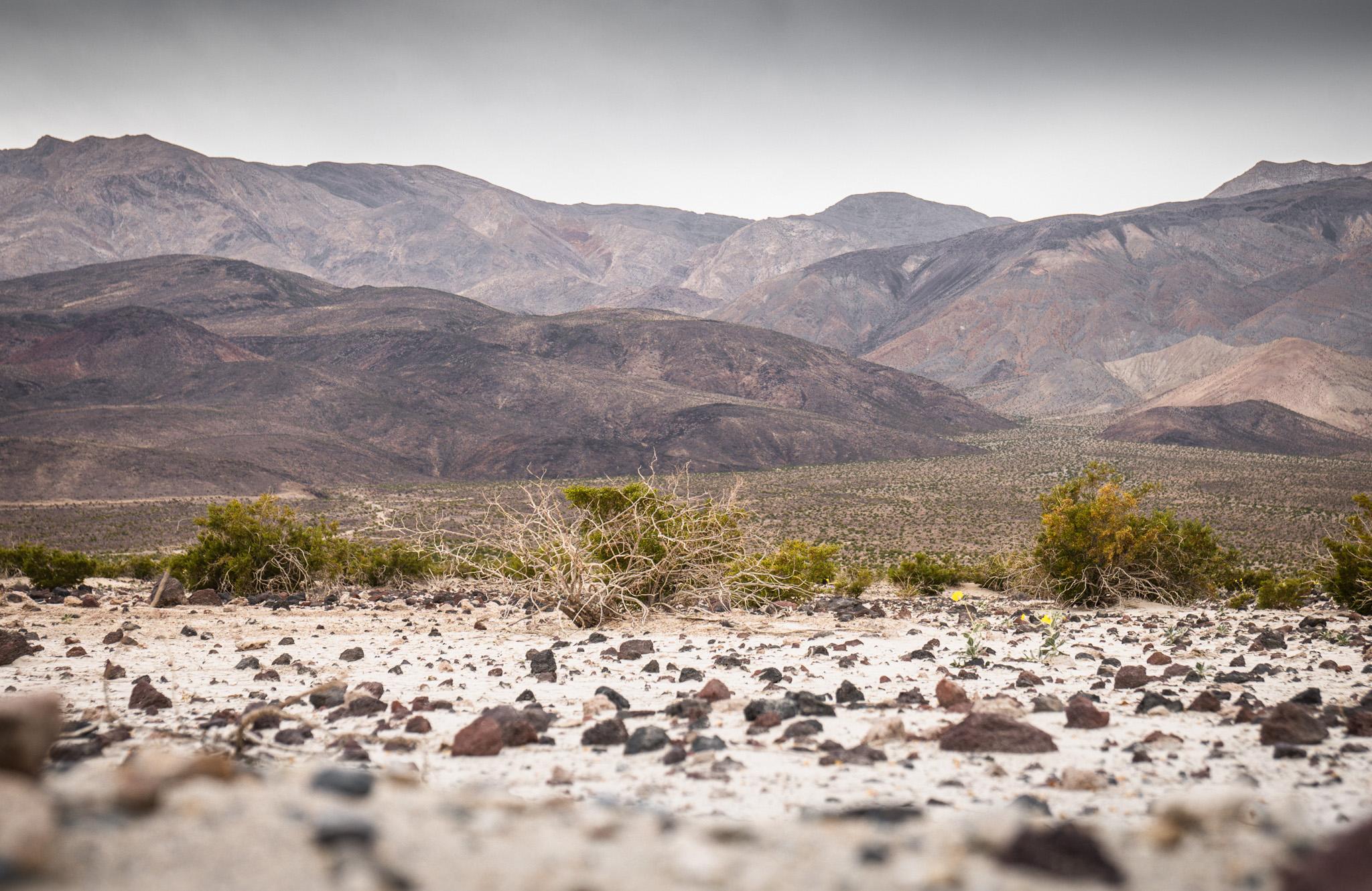
When we thought of Death Valley – one of the hottest places on Earth, where temperatures can reach 50°C – we imagined a dry, barren landscape. The name only reinforced this image – a place devoid of life, hostile, almost lifeless. However, as we drove toward Panamint Springs, instead of emptiness, a sea of undulating yellow flowers appeared, interspersed here and there with patches of green. These shy flowers, known as “desert gold,” covered the plains, transforming Death Valley into a place that was anything but what we expected.
The rains brought by Hurricane Hilary, which were a disaster for people, marked a new beginning for nature. For Death Valley, it was the water of life that allowed thousands of seeds – hidden beneath layers of rocks and sand, waiting for better times – to sprout and bloom once again. And that was just the beginning. In April, when we were already in Costa Rica, Death Valley had fully blossomed. We, however, said goodbye to it that day and sped on toward Los Angeles.
We spent a few wonderful days in Death Valley. We spent our days leisurely exploring the area, and our evenings returning to our tiny home, lighting a campfire, and warming our frozen bones in its glow. Sometimes we visited our neighbor, Dave, whom we’d met on our very first day at the campground. While we were at Zabriskie Point, Dave left a bottle of wine and some chopped, ready-to-burn firewood by our tent. That same evening, we took the wine and wood and went to see him. That’s how our friendship began. He told us about his life in the United States, and we told him about our travels and adventures. And sometimes we just sat in silence, gazing together at the glittering starry sky. Later, our paths crossed again in a moment that was extraordinary for us, and maybe someday we’ll write about it, but for today we’ll wrap it up here. And we’re sending you, buddy, if you’re reading this, lots of smiles and warmth! Take care and make your dreams come true!
PRACTICAL INFORMATION ABOUT DEATH VALLEY – WHAT IS THE BEST TIME TO VISIT DEATH VALLEY?
Recently, the American media reported the tragic news of a motorcyclist’s death in Death Valley due to heatstroke. Six of his companions, with whom he was traveling, were transported by helicopter to the hospital with symptoms of heatstroke. This tragedy likely would not have occurred if the warnings had not been ignored – Death Valley is considered one of the hottest places on Earth for a reason.
In the summer, temperatures here regularly reach 40-45°C, and the highest recorded temperature is nearly 57°C. Despite the extreme conditions, the other seasons tend to be much milder, and even in winter, snow sometimes falls in the surrounding mountains.
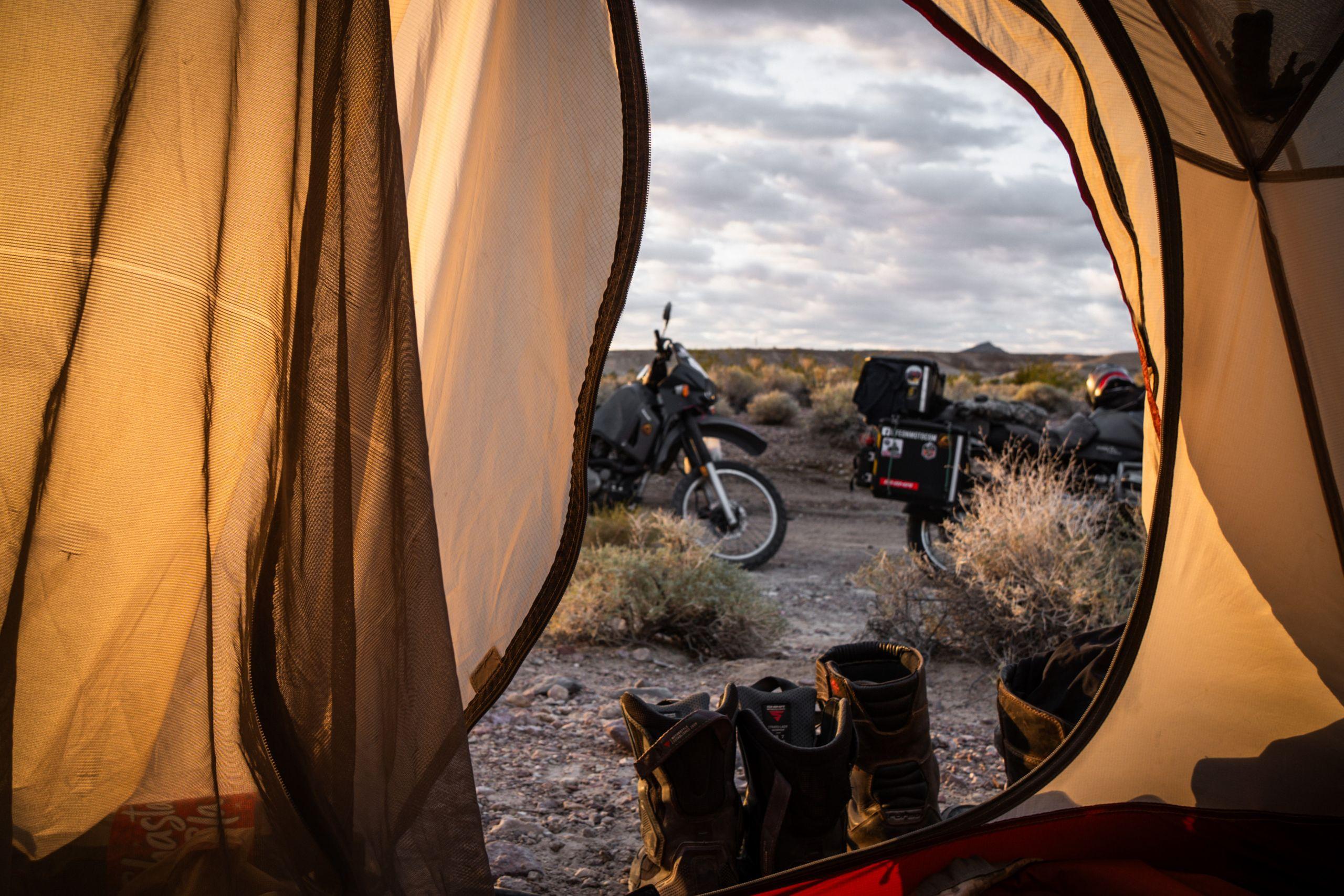
We visited Death Valley at the beginning of winter, and it would have been hard to pick a better time. During the day, it was pleasantly warm, and the sun wasn’t as intense as one might expect. The nights also turned out to be milder than we’d anticipated – in fact, we actually felt colder in Joshua Tree National Park than we did here.
MOTORCYCLING THROUGH THE VALLEY OF RUBBISH—WHERE TO STAY?
When it comes to accommodations, Death Valley has something for everyone. This includes both long-distance travelers on a tight budget and those planning a more lavish getaway. You’ll find plenty of free areas where you can pitch a tent, as well as state campgrounds, private campgrounds, and even a few luxury resorts right in the heart of the desert, surrounded by palm trees. Below is some useful information for those who, like us, prefer to sleep under the stars.
- In Death Valley, you can pitch a tent along almost any dirt road. It’s important to leave your car by the road and set up your tent at least a mile away from it. Some very popular spots include Echo Canyon Road, Hole in the Wall Road, Cottonwood Canyon Road, Racetrack Road, and Warm Springs Canyon Road.
- Death Valley offers as many as 9 campgrounds! Some are open year-round, others are seasonal, and the standards vary widely – some don’t even have access to water. The most famous and best-equipped is Furnace Creek Campground, which is best booked in advance, as spots there fill up quickly. The other year-round campgrounds are: Mesquite Spring, Emigrant, and Wildrose. They operate on a first-come, first-served basis. Sunset, Texas Springs, and Stovepipe Wells are seasonal campgrounds, while Mahogany Flat and Thorndike are campgrounds accessible only via a gravel road and lack any infrastructure.
- Fiddlers Campground, Stovepipe Wells RV Park, and Panamint Springs Resort are private campgrounds located at resorts. Advance reservations are required here, and you can find information about them on the specific hotel websites.
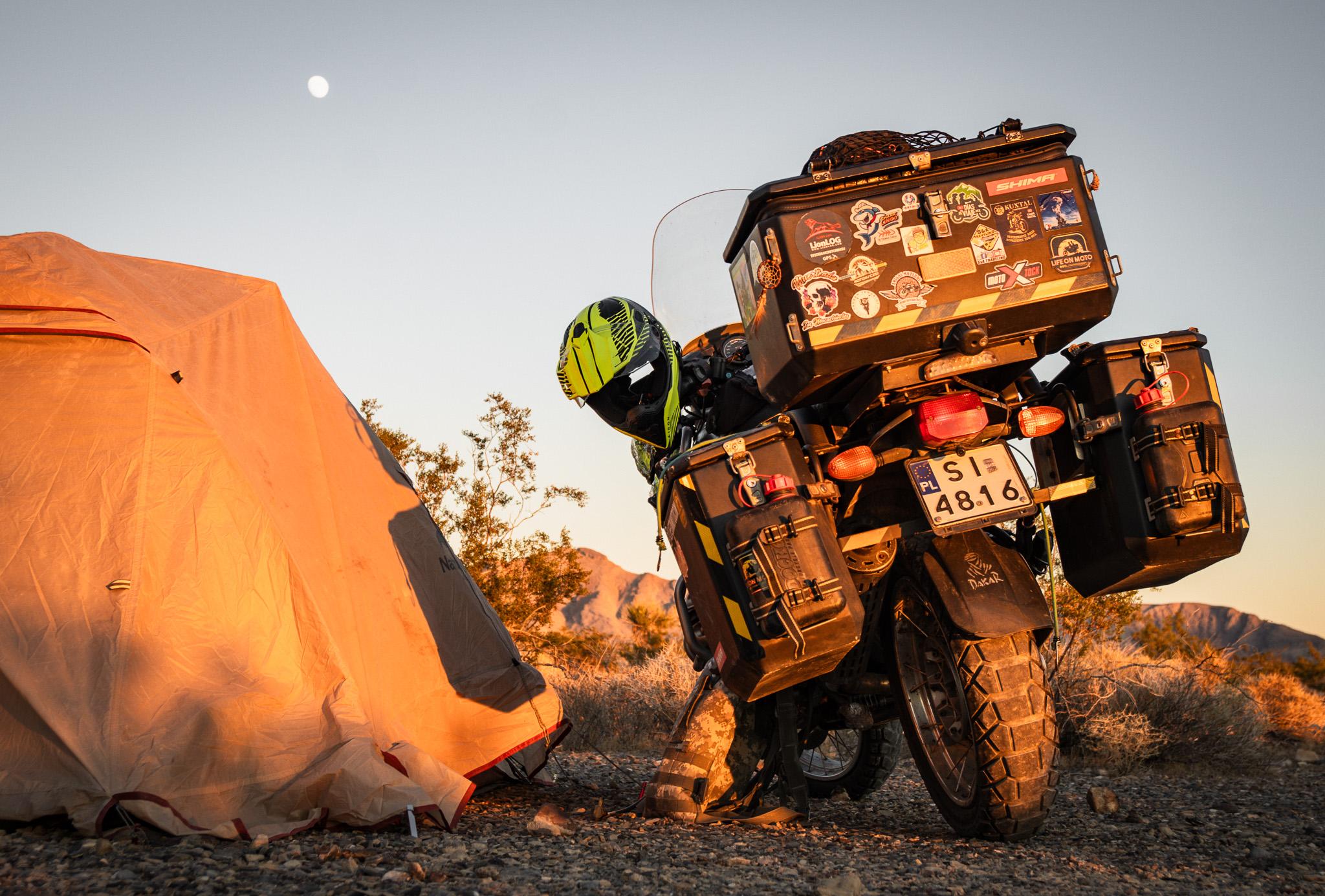
P.S. We didn’t manage to replace the handlebar until we got to Los Angeles and saw our mechanic, Ryan, and when we arrived, there were brand-new handlebars lying right next to it.
